How to Plan a Corporate Gala Dinner That Leaves a Lasting Impression
Plan a corporate gala dinner from vision to execution. Covers venue, entertainment, menu, seating strategy, registration, and budget breakdown.
February 24, 202611 min read
Introduction
A corporate gala dinner is the pinnacle of formal event planning. When executed with precision and creativity, a gala creates an atmosphere of significance — the kind of evening that attendees talk about for months, that strengthens relationships between stakeholders, and that positions your organization as one that does things at the highest level.
When executed poorly, it is an expensive dinner in a ballroom where people eat lukewarm chicken, sit through awkward speeches, and leave early.
The difference between these outcomes is not primarily about budget. It is about design. The most memorable galas succeed because every element — from the invitation to the last dance — is orchestrated to serve a cohesive vision.
According to a 2025 Special Events magazine industry survey, the average corporate gala costs $250–$450 per attendee, but satisfaction scores show almost no correlation with per-person spending above $300. What does correlate with satisfaction? Quality of entertainment, thoughtful seating, smooth logistics, and a program that respects attendees' time.
This guide will walk you through planning a corporate gala that delivers on all four.
Setting the Vision
Every gala needs a clear purpose. "We're having a fancy dinner" is not a purpose. These are:
FUNDRAISER GALA
The most traditional gala format. The evening is structured around raising money for a cause — the company's foundation, a nonprofit partner, or a community initiative. Programming includes an appeal, auction (silent, live, or both), and donor recognition. Success is measured in dollars raised.
AWARDS GALA
Recognizes outstanding achievements by employees, partners, or clients. Programming centers on an awards ceremony with video tributes, speeches, and presentations. Success is measured in recipient satisfaction and audience engagement.
MILESTONE CELEBRATION
Marks a significant company anniversary, achievement, or transition. Programming blends retrospective storytelling with forward-looking vision. Success is measured in attendee sentiment and stakeholder alignment.
CLIENT APPRECIATION GALA
Thanks your most important clients for their partnership. Programming emphasizes hospitality, entertainment, and relationship building. Success is measured in client satisfaction and subsequent retention or expansion.
Your gala's purpose dictates every subsequent decision — venue, program length, entertainment style, seating strategy, and budget allocation. Define it first and refer back to it with every decision.
Venue Selection
The venue is the canvas your gala is painted on. Choose wrong, and no amount of decor can compensate.
CAPACITY CONSIDERATIONS
A gala venue needs more than enough seats. You need space for:
• Reception area — where guests arrive, mingle, and enjoy cocktails before dinner (plan for 30–60 minutes of reception time)
• Dining floor — round tables of 8–10 with adequate spacing (minimum 60 inches between tables for guest and server movement)
• Stage area — for speakers, performers, and presenters (raised stage with professional lighting)
• Dance floor — if your gala includes dancing (minimum 3 square feet per expected dancer)
• Auction display (if applicable) — a visible, accessible area for silent auction items
• AV and production — space for sound boards, lighting rigs, and camera positions
• Kitchen and service staging — proximity to the dining floor for timely food service
Rule of thumb: your venue should comfortably hold 20–30% more people than your expected attendance to avoid feeling cramped.
ACOUSTICS
This is the factor most planners underestimate. A beautiful venue with terrible acoustics will ruin your entire program. If guests cannot hear the keynote speaker or the awards presentations, the evening fails.
• Visit the venue and test sound levels from multiple positions in the room
• Ask about built-in sound systems and acoustic treatments
• Budget for professional sound reinforcement if the venue's native acoustics are suboptimal
• Consider the ceiling height — very high ceilings (over 25 feet) create echo; very low ceilings (under 12 feet) amplify crowd noise
CATERING CAPABILITIES
Ask these questions of every venue:
• Is catering in-house or can you bring in an outside caterer?
• What is the kitchen capacity? Can they execute multi-course plated service for your attendee count?
• How many dietary variations can they accommodate simultaneously?
• What is their staff-to-guest ratio for plated service? (Industry standard: one server per 15–20 guests for plated dinner, one per 25–30 for buffet)
• Can they accommodate a tasting session for the planning team?
VENUE TYPES
Venue Type: Hotel ballroom | Pros: Reliable, experienced staff, built-in AV | Cons: Can feel generic | Price Range Per Person: $150–$350
Venue Type: Historic mansion or estate | Pros: Unique atmosphere, photo-worthy | Cons: Limited capacity, parking challenges | Price Range Per Person: $200–$500
Venue Type: Museum or gallery | Pros: Stunning aesthetic, conversation starters | Cons: Restrictions on decor and food/drink | Price Range Per Person: $250–$600
Venue Type: Rooftop or outdoor | Pros: Dramatic setting, memorable views | Cons: Weather dependency, noise restrictions | Price Range Per Person: $200–$450
Venue Type: Industrial or warehouse space | Pros: Blank canvas, trendy aesthetic | Cons: Requires more decor investment, infrastructure gaps | Price Range Per Person: $100–$300 (plus significant decor)
Venue Type: Country club or resort | Pros: Elegant, full-service, scenic | Cons: Can feel traditional, limited availability | Price Range Per Person: $200–$400
Theme and Decor
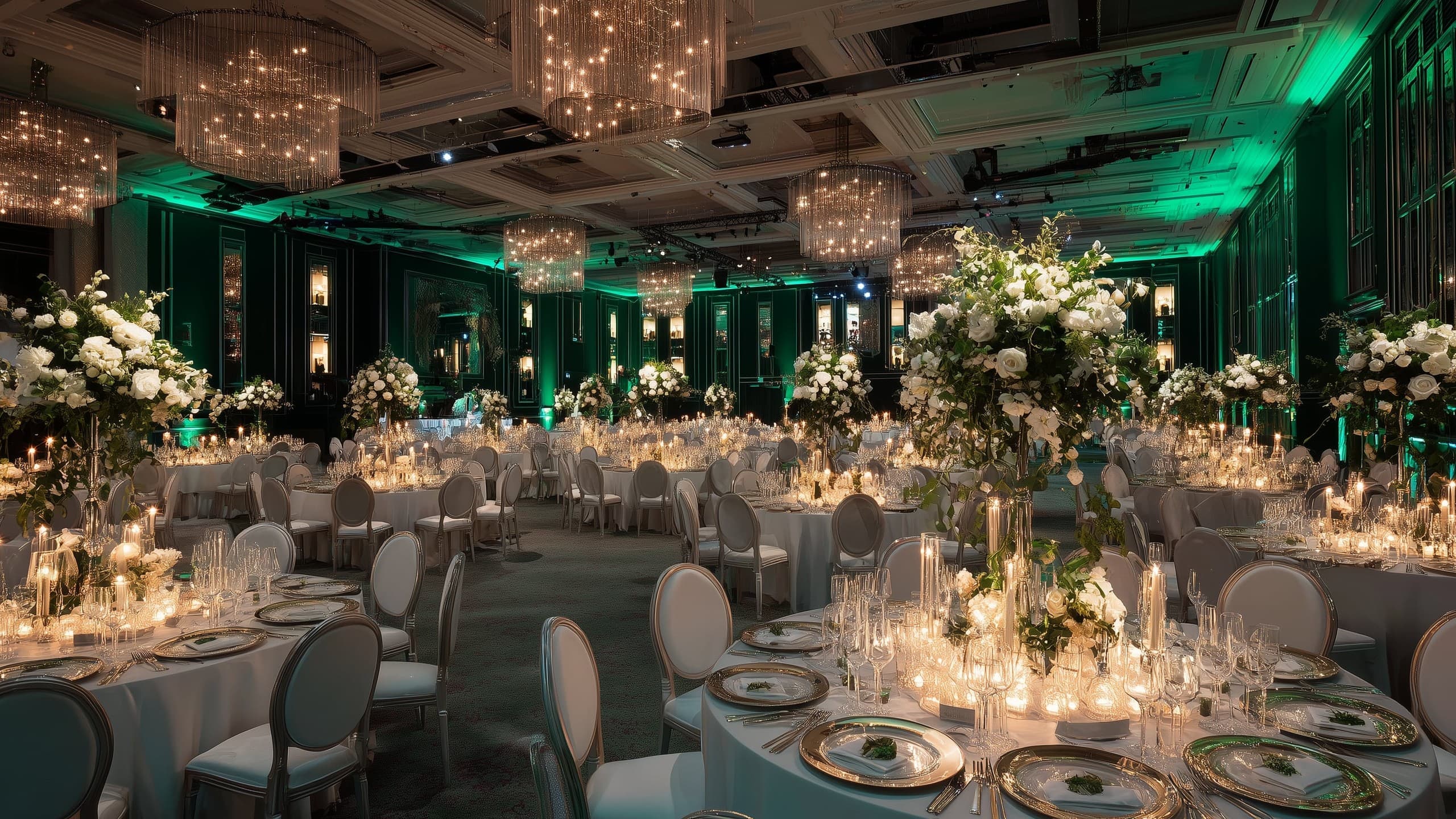
A cohesive theme elevates a dinner into an experience. The theme should connect to your gala's purpose and your brand identity.
THEME DEVELOPMENT
• Fundraiser galas often use themes tied to the cause: "A Night Under the Stars" for an environmental charity, "Masquerade for Hope" for a medical research foundation
• Awards galas can draw from the year's achievements: "The Year We Broke Through," "Celebrating Excellence," or a decade theme if it is a milestone year
• Client appreciation galas benefit from aspirational themes: "An Evening of Distinction," "The Art of Partnership"
Whatever your theme, commit to it fully. Half-hearted theming is worse than no theme at all.
DECOR ELEMENTS
• Centerpieces — the most visible table element. Budget $50–$200 per table for floral arrangements or $30–$100 for non-floral alternatives (candles, sculptures, themed displays)
• Lighting — professional lighting transforms any venue. Uplighting, pin spots on centerpieces, and programmed lighting cues during presentations are standard for galas. Budget $3,000–$10,000 for a professional lighting design.
• Linens — table linens, chair covers, and napkins in your color scheme. Budget $15–$40 per guest.
• Signage and branding — welcome signs, menu displays, event branding, sponsor recognition, and directional signage
• Entry experience — the first impression matters enormously. Consider a red carpet, branded photo backdrop, or atmospheric lighting at the entrance
Entertainment
Entertainment sets the emotional tone of the evening. Choose based on your audience demographic, gala purpose, and the energy you want to create.
KEYNOTE SPEAKER
For awards and milestone galas, a keynote speech anchors the program. Options include:
• Internal executive — authentic, personal, but requires strong public speaking skills and genuine content
• Industry leader — lends external credibility and provides fresh perspective. Budget $5,000–$50,000+ depending on profile
• Motivational speaker — energizes the room and provides a memorable takeaway. Budget $10,000–$100,000+ for nationally recognized names
• Celebrity host — draws attendance and creates media buzz. Budget varies enormously
LIVE MUSIC
Live music elevates the atmosphere in ways that a DJ alone cannot match. Consider:
• Jazz ensemble (during dinner) — sophisticated background music that encourages conversation. Budget $1,500–$5,000
• Cover band (after dinner/dancing) — energizes the dance floor and extends the evening. Budget $3,000–$15,000
• Solo performer (during reception) — pianist, guitarist, or vocalist for cocktail hour. Budget $500–$2,000
• DJ (dance portion) — reliable energy and song variety for the dance floor. Budget $1,000–$5,000
PROGRAMMING FLOW
A well-paced gala program keeps the audience engaged without feeling rushed or drawn out:
Time: 6:00 PM | Segment: Cocktail reception and arrival | Duration: 45–60 min
Time: 7:00 PM | Segment: Doors open, guests seated | Duration: 15 min
Time: 7:15 PM | Segment: Welcome and opening remarks | Duration: 5–10 min
Time: 7:25 PM | Segment: First course served | Duration: 15–20 min
Time: 7:45 PM | Segment: Keynote or featured presentation | Duration: 15–20 min
Time: 8:05 PM | Segment: Main course served | Duration: 25–30 min
Time: 8:35 PM | Segment: Awards or program highlight | Duration: 20–30 min
Time: 9:05 PM | Segment: Dessert served | Duration: 15 min
Time: 9:20 PM | Segment: Closing remarks and call to action | Duration: 5–10 min
Time: 9:30 PM | Segment: Dancing and social | Duration: 90–120 min
Time: 11:00 PM | Segment: Event concludes
Critical rule: keep the formal program to under 90 minutes total. Gala audiences begin to disengage after 90 minutes of seated programming, regardless of content quality.
Menu Planning
Food quality is the second-most-mentioned factor in gala satisfaction surveys (after entertainment). Plan it with care.
SERVICE STYLE
• Plated multi-course — the most formal and traditional. Allows precise portion control and presentation. Requires more serving staff. Best for seated galas under 300 attendees.
• Buffet — more casual, offers variety, accommodates dietary restrictions more easily. Works well for larger events. Requires careful flow design to avoid long lines.
• Stations — a modern alternative to buffets. Food stations positioned around the room encourage movement and mingling. Works beautifully during extended receptions.
• Family style — platters placed on each table for guests to share. Creates a warm, communal atmosphere. Requires tables large enough to accommodate serving platters.
MENU DESIGN
• Offer three courses minimum: starter, main, dessert
• Include a vegetarian main course option that is genuinely appealing — not an afterthought pasta dish
• Accommodate the major dietary categories: vegetarian, vegan, gluten-free, kosher, halal, and common allergies (nuts, dairy, shellfish)
• Schedule a menu tasting with your caterer 6–8 weeks before the event
DIETARY ACCOMMODATIONS AT SCALE
For galas with 200+ attendees, dietary management becomes a logistical challenge. A 2025 National Restaurant Association study found that 36% of adults follow at least one dietary restriction. For a 300-person gala, that means 100+ guests may need accommodations.
Best practices:
• Collect dietary information during registration (not as an afterthought in a pre-event email)
• Code dietary requirements on seating charts and share with catering staff
• Place dietary-specific meals at individual settings before guests are seated
• Have additional special meals prepared as backup (attendees sometimes change tables or bring unexpected plus-ones)
• Brief serving staff on which tables have special dietary requirements
Seating Strategy
Seating at a gala is strategic, not random. Who sits next to whom shapes the conversations, relationships, and energy of the entire evening.
VIP PLACEMENT
• Seat your most important guests (keynote speakers, top donors, executive leadership, distinguished clients) at tables closest to the stage with clear sightlines
• Place a senior host or executive at each VIP table to ensure conversation and hospitality
• Brief VIP hosts on key facts about their tablemates so they can facilitate introductions
NETWORKING OPTIMIZATION
• Mix attendees from different companies, departments, or backgrounds at each table to encourage new connections
• Place people with complementary interests or potential business synergies together
• Avoid seating married couples or close colleagues at the same table — they will talk to each other regardless; use the seating to expand their networks
TABLE CONFIGURATION
• Round tables of 8–10 are standard for galas (8 is more intimate and easier for full-table conversation; 10 maximizes capacity)
• Ensure every seat has a clear sightline to the stage — no one wants to sit with their back to the program and twist in their chair for 90 minutes
• Number tables clearly and include a seating chart display at the entrance
• Place name cards at individual settings to guide guests to their seats
Timeline: Starting 6–9 Months Ahead
Timeframe: 9 months out | Action Items: Define gala purpose and vision, set preliminary budget, begin venue research
Timeframe: 6 months out | Action Items: Book venue, secure entertainment and keynote speaker, establish theme
Timeframe: 5 months out | Action Items: Engage decor, lighting, and AV vendors; design invitations and branding
Timeframe: 4 months out | Action Items: Send save-the-date communications, open sponsorship solicitation (if applicable)
Timeframe: 3 months out | Action Items: Send formal invitations, open registration, finalize menu with caterer
Timeframe: 2 months out | Action Items: Manage RSVPs, begin seating strategy, confirm all vendor contracts
Timeframe: 6 weeks out | Action Items: Menu tasting, order linens, finalize decor design, begin program scripting
Timeframe: 1 month out | Action Items: Close RSVP, finalize seating chart, production rehearsal, prepare awards/tributes
Timeframe: 2 weeks out | Action Items: Print place cards and programs, final vendor confirmations, brief all staff
Timeframe: 1 week out | Action Items: Venue walkthrough, final AV rehearsal, prepare registration materials
Timeframe: Day of | Action Items: Execute with precision
Budget Breakdown
Here is a realistic budget breakdown for a 250-person corporate gala:
Category: Venue rental | Percentage: 15–25% | Dollar Range: $7,500–$25,000
Category: Catering (food and beverage) | Percentage: 30–40% | Dollar Range: $22,500–$50,000
Category: Entertainment | Percentage: 10–15% | Dollar Range: $5,000–$15,000
Category: Decor and florals | Percentage: 10–15% | Dollar Range: $5,000–$15,000
Category: AV and lighting | Percentage: 8–12% | Dollar Range: $5,000–$12,000
Category: Photography and videography | Percentage: 3–5% | Dollar Range: $2,000–$5,000
Category: Invitations and print materials | Percentage: 2–3% | Dollar Range: $1,500–$3,000
Category: Staffing and coordination | Percentage: 3–5% | Dollar Range: $2,000–$5,000
Category: Contingency | Percentage: 10% | Dollar Range: $5,000–$12,000
Category: Total | Percentage: 100% | Dollar Range: $55,500–$142,000
Per-person cost: $222–$568
Dress Code Communication
Ambiguity about dress code creates anxiety for guests. Be explicit and specific in your invitations:
• Black Tie — tuxedos for men, floor-length gowns for women. The most formal option.
• Black Tie Optional — tuxedos or dark suits for men, formal gowns or cocktail dresses for women. The most common gala dress code.
• Cocktail Attire — suits or sport coats for men, cocktail dresses or dressy separates for women. Appropriate for less formal galas.
• Creative Black Tie — formal with a twist. Encourages personal expression within a formal framework.
Include dress code information on the invitation, on the registration page, and in the pre-event logistics email. Consider including a brief description or visual guide for attendees who may be unfamiliar with formal dress codes.
Registration and Check-In Flow
The guest arrival experience sets the tone for the entire evening. A smooth, elegant check-in process signals that every detail has been considered.
PRE-EVENT REGISTRATION
• Collect full names (for place cards), dietary restrictions, and any accessibility needs during registration
• Confirm attendance 2–3 weeks before the event with a detailed logistics email (venue address, parking, dress code, schedule)
• For events with table assignments, provide table numbers in the confirmation email or at a welcome display upon arrival
DAY-OF CHECK-IN
• Station greeters at the entrance to direct guests to the check-in area
• Use a streamlined check-in process — guests should be checked in within 30 seconds
• Provide a printed or digital seating chart display prominently near the entrance
• Have staff available to escort guests to their tables, especially VIPs
• Brief check-in staff on pronunciation of guest names (nothing kills elegance faster than mangling a guest's name)
Eventifia's attendee tracking and real-time check-in dashboards streamline gala registration from the first RSVP to the final guest arrival. Track seating assignments, dietary codes, and VIP status in one system, and give your on-site team a real-time view of who has arrived and who is still expected. When your gala host asks "Is the keynote speaker here yet?" your team has the answer instantly.
Post-Gala Follow-Up
WITHIN 48 HOURS
• Send a thank-you email to all attendees with highlights and professional photos
• Publish social media content (photographer's highlights, video clips, guest reactions)
• For fundraiser galas, communicate total funds raised and thank donors specifically
WITHIN 1 WEEK
• Send a post-event survey (brief — 5–7 questions focused on experience quality and suggestions)
• Process all vendor invoices and reconcile the budget
• Conduct an internal debrief with the planning team
WITHIN 1 MONTH
• Deliver a comprehensive event report to stakeholders (attendance, budget, satisfaction scores, key outcomes)
• Begin planning conversations for next year's gala based on survey feedback
• Archive photos, videos, and planning documents for future reference
Create an Evening Worth Remembering
A corporate gala is more than a dinner party with a bigger budget. It is an opportunity to create an experience that strengthens relationships, celebrates achievements, advances your cause, and positions your organization as one that operates with excellence and intention.
Plan early. Invest in the details that matter most — entertainment, acoustics, seating, and smooth logistics. Respect your guests' time with a program that is engaging and well-paced.
Eventifia provides the operational backbone for your gala — from registration and seating management to real-time check-in and post-event analytics. When the logistics are handled seamlessly, you are free to focus on creating the kind of evening that leaves a lasting impression.
Plan your corporate gala with Eventifia at eventifia.com — and give your guests an experience that matches your organization's ambition.