Corporate Retreat Planning: From Vision to Execution
Plan a corporate retreat that drives real results. Covers objectives, venue selection, agenda design, budgeting, and post-retreat follow-through.
February 24, 202611 min read
Introduction
A corporate retreat is one of the most powerful — and most expensive — investments an organization can make in its people. Done well, a retreat can reset team dynamics, accelerate strategic alignment, spark breakthrough ideas, and build the kind of trust that months of Slack messages and video calls never will.
Done poorly, it is a six-figure waste of time that leaves people more cynical than when they arrived.
The difference comes down to intentional design. Too many companies treat retreats as vacations with a few meetings sprinkled in. The result is pleasant but forgettable. The best retreats balance structured programming with organic connection, challenge participants without burning them out, and produce tangible outcomes that extend far beyond the event itself.
This guide covers every phase of corporate retreat planning — from defining your objectives to following through on what you build during the experience.
Defining Retreat Objectives
Every successful retreat starts with a clear answer to one question: why are we doing this?
The answer should not be "because we haven't done one in a while" or "because other companies do them." It should be a specific, strategic objective that justifies the investment.
COMMON RETREAT OBJECTIVES
Strategic alignment — the leadership team needs to align on company direction, annual planning, or a major strategic shift. The retreat provides uninterrupted time to think deeply and debate openly without the distractions of daily operations.
Team building and culture — the team needs to build stronger relationships, especially if it has grown significantly, experienced turnover, or operates in a remote or hybrid model. A 2025 Buffer State of Remote Work report found that 52% of remote workers cite loneliness and disconnection as their biggest challenge. Retreats directly address this.
Innovation and problem-solving — the organization needs fresh thinking on a specific challenge. Removing people from their usual environment and routines unlocks creative thinking. A 2025 study published in the Journal of Organizational Behavior found that teams generate 35% more novel ideas in offsite settings compared to their regular office environment.
Celebration and recognition — the team has achieved something significant and deserves to celebrate together. Shared celebration builds the emotional foundation for the next wave of hard work.
Onboarding and integration — following a merger, acquisition, or major hiring wave, a retreat accelerates cultural integration and relationship building.
Choose one primary objective and one or two secondary objectives. Trying to accomplish everything dilutes everything.
Choosing the Right Venue
Your venue shapes the retreat experience more than any other single decision. It sets the tone, enables or constrains your programming, and communicates what the company values.
URBAN VS. RURAL
Urban retreats work well for teams that want cultural experiences, dining options, and nightlife. They are easier for travel logistics and offer more venue flexibility. However, they make it harder to create a sense of separation from daily life — attendees can easily check into the office, grab a coffee with a local friend, or spend breaks on their phone.
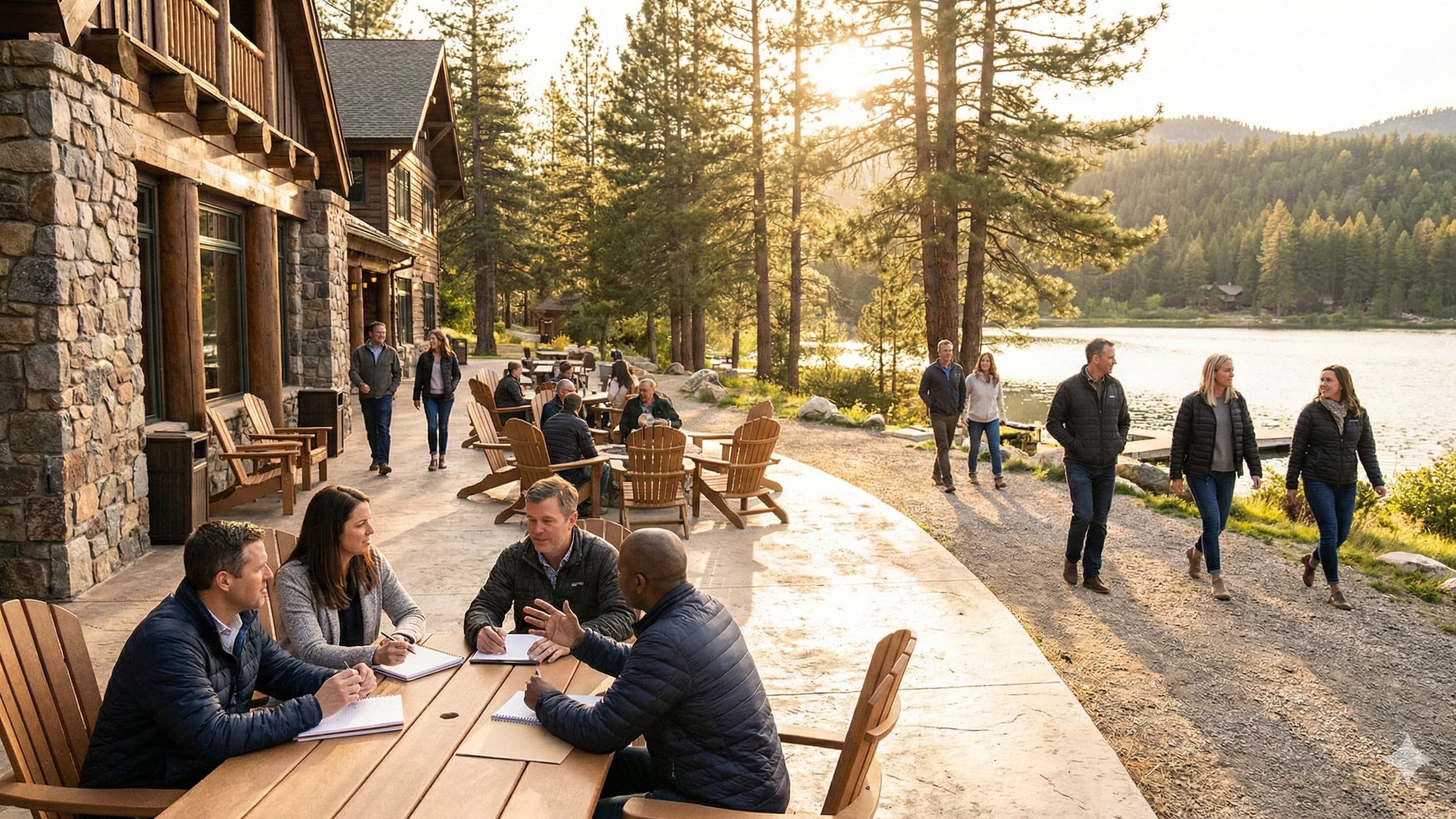
Rural or nature retreats create a stronger sense of "being away." Mountain lodges, lakeside resorts, ranch properties, and coastal retreats encourage people to disconnect and be present. The tradeoff: limited entertainment options and potentially complex travel logistics.
Recommendation: For strategic and team-building retreats, rural or semi-rural venues produce better outcomes. For innovation sprints and celebrations, urban venues offer more stimulation and flexibility.
DOMESTIC VS. INTERNATIONAL
Domestic retreats are logistically simpler — no passport requirements, no visa complications, easier travel coordination, and lower transportation costs. For most organizations, domestic is the right default.
International retreats create extraordinary experiences and signal investment in the team. But they add significant complexity: travel visas, jet lag, longer travel time (which reduces productive retreat time), cultural considerations, and higher budgets.
Recommendation: Reserve international destinations for senior leadership retreats, major milestone celebrations, or organizations with global teams where a neutral international location puts everyone on equal footing.
VENUE EVALUATION CHECKLIST
☐ Sleeping accommodations for all attendees (single rooms strongly preferred — sharing rooms creates unnecessary tension)
☐ Meeting spaces that accommodate your programming needs (main room, breakout rooms, informal gathering spaces)
☐ AV equipment and reliable Wi-Fi
☐ Dining capacity for group meals
☐ Outdoor space for activities and informal gatherings
☐ Recreational amenities (pool, hiking trails, fitness center, spa)
☐ Accessibility for team members with mobility needs
☐ Proximity to the nearest airport (under 90 minutes is ideal)
☐ Available dates that work for your team
☐ On-site event coordination support
☐ Alcohol policy and options (if relevant)
☐ Dietary accommodation capability
Agenda Design: Balancing Structure and Freedom
The retreat agenda is where most planners go wrong. The two failure modes:
Over-scheduled: Back-to-back sessions from 8 AM to 8 PM with no breathing room. People are exhausted by day two and resentful by day three. Creativity requires mental space.
Under-scheduled: "We'll figure it out when we get there." Without structure, retreats devolve into extended coffee breaks with occasional awkward attempts at meaningful conversation.
THE IDEAL RHYTHM
Morning (3–4 hours of structured programming): This is when energy and focus are highest. Schedule your most important strategic sessions, workshops, and collaborative work here.
Afternoon (2–3 hours of activity or lighter programming): Balance structured activities with free time. Offer options — a group hike, a team activity, a workshop, or simply free time to explore, rest, or have informal conversations.
Evening (social and connection): Group dinners, campfire conversations, entertainment, or simply time to relax together. Do not schedule work sessions in the evening except in rare circumstances.
SAMPLE 3-DAY RETREAT AGENDA
Day 1: Arrive and Connect
• 12:00 PM — Arrival and lunch
• 2:00 PM — Welcome session: retreat objectives, expectations, and agenda overview
• 2:30 PM — Icebreaker activity (something genuine, not forced — a facilitated storytelling exercise works well)
• 4:00 PM — Free time to settle in and explore the venue
• 6:30 PM — Group dinner and social evening
Day 2: Deep Work
• 8:00 AM — Breakfast
• 9:00 AM — Strategic session 1 (the core topic that requires the most energy and focus)
• 11:00 AM — Break
• 11:30 AM — Strategic session 2 (breakout groups working on specific challenges)
• 1:00 PM — Lunch
• 2:30 PM — Team activity (choose from 2–3 options to accommodate different preferences)
• 5:00 PM — Free time
• 7:00 PM — Group dinner with recognition or awards element
Day 3: Synthesize and Commit
• 8:00 AM — Breakfast
• 9:00 AM — Breakout groups present findings and recommendations
• 10:30 AM — Full group discussion: decisions, commitments, and action items
• 12:00 PM — Closing session: reflections, appreciation, next steps
• 12:30 PM — Lunch and departure
ACTIVITIES THAT DRIVE RESULTS
The right activities reinforce your retreat objectives rather than existing as entertainment filler.
For strategic alignment: Facilitated strategy workshops, scenario planning exercises, competitive analysis war games, customer empathy mapping sessions.
For team building: Collaborative cooking experiences, outdoor adventure challenges, creative workshops (painting, music, improv), scavenger hunts, volunteer projects.
For innovation: Design thinking sprints, hackathons, "shark tank" pitch sessions, cross-functional brainstorming with structured frameworks.
For celebration: Awards ceremonies, talent shows, group outings (concerts, sporting events, local experiences), storytelling sessions where team members share career highlights.
Food and Accommodation Logistics
Never underestimate the impact of food and lodging on retreat satisfaction. Hungry, uncomfortable people do not do their best thinking.
ACCOMMODATION STANDARDS
• Single rooms — this is the standard expectation for corporate retreats. Asking colleagues to share rooms creates unnecessary discomfort, particularly for introverts who need private space to recharge.
• Room assignments — communicate room details in advance. For venues with varying room quality, assign rooms equitably or use a random assignment.
• Arrival and departure coordination — arrange group transportation from the airport or provide clear individual transportation instructions.
CATERING APPROACH
• Survey dietary restrictions well in advance (allergies, vegetarian/vegan, kosher/halal, gluten-free, other restrictions)
• Plan for variety — the same food three days in a row creates complaints
• Include healthy options — heavy meals lead to afternoon energy crashes
• Keep snacks and beverages available continuously — coffee, tea, water, fruit, and light snacks should be accessible at all times
• Alcohol policy — if alcohol is served, always provide equally appealing non-alcoholic alternatives and never pressure participation
Budget Planning
Corporate retreat costs vary widely based on location, accommodation level, activities, and duration. Here are realistic per-person, per-day ranges for 2026:
Retreat Tier: Budget | Cost Per Person Per Day: $200–$350 | Includes: Basic hotel, standard catering, minimal activities
Retreat Tier: Mid-range | Cost Per Person Per Day: $350–$600 | Includes: Quality resort, full catering, 2–3 organized activities
Retreat Tier: Premium | Cost Per Person Per Day: $600–$1,000 | Includes: Luxury property, gourmet catering, premium activities, facilitation
Retreat Tier: Ultra-premium | Cost Per Person Per Day: $1,000+ | Includes: Destination resort, world-class dining, exclusive experiences
For a 30-person, 3-day retreat:
• Budget tier: $18,000–$31,500
• Mid-range: $31,500–$54,000
• Premium: $54,000–$90,000
Additional costs to budget for:
• Professional facilitation ($5,000–$15,000 for a 2–3 day retreat)
• Transportation (flights, ground transportation, airport transfers)
• AV equipment rental (if not included in venue)
• Swag or gift bags ($25–$100 per person)
• Activity vendors and facilitators
• Travel insurance
• Contingency (10% of total budget)
COST OPTIMIZATION TIPS
• Book during shoulder season (avoid peak holiday periods and summer months)
• Negotiate group rates — most venues offer 15–25% discounts for full buyouts
• Choose venues that include catering in the accommodation rate
• Limit the number of off-site activities that require additional transportation
• Consider Sunday-to-Tuesday scheduling for better venue rates (and less time away from weekends)
For Remote-First Companies: Why Retreats Matter Even More
If your team works remotely, corporate retreats are not a luxury — they are an operational necessity.
Remote teams build functional relationships through Slack and Zoom, but deep trust, nuanced understanding, and genuine friendship require shared physical space and unstructured time together.
A 2025 GitLab study of remote-first companies found that organizations holding at least two company-wide retreats per year report:
• 34% higher employee engagement scores
• 28% lower voluntary turnover
• 41% stronger ratings on "I feel connected to my team" survey questions
REMOTE TEAM RETREAT BEST PRACTICES
Meet more frequently, for shorter durations. Two 3-day retreats per year often delivers more value than one 5-day retreat.
Prioritize unstructured time. Remote teams already do structured work well via their digital tools. What they lack is informal, organic interaction. Build generous free time into the agenda.
Mix familiar and unfamiliar pairings. Cross-functional seating at meals, random team assignments for activities, and structured one-on-one coffee chats help people build relationships beyond their immediate team.
Accommodate timezone and travel disparities. Team members traveling from different continents have different energy levels and adjustment needs. Build buffer time into the agenda, especially on arrival day.
Do not try to replicate the office. The point of the retreat is not to do regular work in a nicer location. It is to do the things you cannot do remotely — deep relationship building, complex strategic discussions, creative collaboration, and shared experiences.
Post-Retreat Follow-Through
This is where most retreats fail to deliver lasting value. The experience was great, but within two weeks everyone is back to their old routines, and the strategic decisions made at the retreat collect dust.
IMMEDIATE ACTIONS (WITHIN 1 WEEK)
• Distribute a retreat summary: key decisions, action items, owners, and deadlines
• Share photos and highlights (create a shared album or channel)
• Send a post-retreat survey (5–8 questions covering programming quality, logistics satisfaction, and suggestions)
• Schedule follow-up meetings for action items that require additional work
ONGOING FOLLOW-THROUGH (1–3 MONTHS)
• Review retreat action items in regular team meetings (make it a standing agenda item)
• Check in on strategic commitments at 30, 60, and 90 days
• Share progress updates with the full team to maintain momentum
• Address any issues raised in the retreat survey
MEASURING RETREAT ROI
Track these metrics to justify the investment:
• Employee NPS change — survey before and 30 days after the retreat
• Action item completion rate — what percentage of retreat commitments were executed?
• Engagement pulse scores — track in your regular engagement survey
• Retention rate — monitor in the 6 months following the retreat
• Cross-functional collaboration — measure new project collaborations that started at the retreat
• Qualitative feedback — collect specific stories of relationships or ideas that originated at the retreat
Coordinating Multi-Day Retreat Logistics
A multi-day retreat with 30–100+ attendees involves a staggering number of logistics: arrival and departure coordination, room assignments, meal planning, activity scheduling, breakout group assignments, and real-time agenda adjustments.
Eventifia simplifies this by letting you build a comprehensive multi-day schedule within a single event — with individual sessions, activity tracks, and attendee assignments that everyone can access from their phone. Your team sees the agenda in real time, knows where they need to be and when, and your coordination team can make adjustments on the fly without sending a dozen group texts.
For organizations running multiple retreats per year (leadership retreat, department retreats, company-wide offsite), Eventifia's multi-venue support lets you manage all of them from a single platform with consistent processes and centralized data.
From Vision to Execution: Your Retreat Planning Timeline
Timeframe: 4–6 months out | Action Items: Define objectives, set budget, research and book venue
Timeframe: 3 months out | Action Items: Design agenda framework, book facilitator, plan activities
Timeframe: 2 months out | Action Items: Open registration, collect dietary/travel/accessibility info
Timeframe: 6 weeks out | Action Items: Finalize agenda, confirm all vendors and activities
Timeframe: 1 month out | Action Items: Send detailed attendee guide (packing list, agenda, logistics)
Timeframe: 2 weeks out | Action Items: Confirm all logistics, room assignments, transportation
Timeframe: 1 week out | Action Items: Final attendee communication with last-minute details
Timeframe: Day of | Action Items: Execute with flexibility and presence
Timeframe: 1 week after | Action Items: Distribute summary, send survey, begin action item tracking
Timeframe: 1–3 months after | Action Items: Follow through on commitments, measure impact
Make Every Retreat Count
A corporate retreat is an investment of time, money, and trust. Your team is giving you their time away from home, away from their routines, away from their comfort zones. Respect that investment by planning an experience worthy of it.
Define clear objectives. Choose a venue that sets the right tone. Design an agenda that balances depth and breathing room. And follow through on everything that happens there.
Explore how Eventifia can help you coordinate your next corporate retreat at eventifia.com — from multi-day scheduling to real-time attendee management, so you can focus on creating an experience your team will talk about for years.