Corporate Team Building Events That People Actually Enjoy
Discover team building event ideas that boost morale and drive results. Covers creative, adventure, skill-building, and virtual options for every budget.
February 24, 202610 min read
Introduction
The words "mandatory team building" can make even the most enthusiastic employee suppress a groan. And honestly, they have earned that reaction.
Too many corporate team building events follow the same script: gather everyone in a conference room, play an awkward icebreaker, do a trust fall or two, and call it "culture building." The result is a few hours of forced fun that accomplishes nothing except reinforcing the idea that leadership is out of touch.
But here is the thing — team building, done well, genuinely works. A 2025 Harvard Business Review analysis found that teams who participate in well-designed collaborative activities show a 25% improvement in communication effectiveness and a 20% increase in project completion rates over the following quarter. Gallup data from the same year shows that organizations with strong team cohesion report 23% higher profitability.
The difference between team building that works and team building that becomes an office joke comes down to three principles: relevance, authenticity, and choice. This guide covers all three, with specific event ideas that your team will actually look forward to.
Why Most Team Building Fails
Before diving into ideas, it is worth understanding the failure modes so you can avoid them.
FORCED FUN
Making an event mandatory and then asking people to "have fun" creates a contradiction. Adults do not enjoy being told how to feel. The solution: make participation genuinely appealing and give people options within the experience.
NO CONNECTION TO REAL WORK
Generic trust exercises and personality quizzes feel disconnected from the actual challenges your team faces. The best team building experiences either directly build skills your team needs or create shared experiences that translate into better working relationships.
ONE-SIZE-FITS-ALL DESIGN
Your team is made up of introverts and extroverts, athletes and bookworms, parents who need to get home and twenty-somethings looking for a night out. Designing a single activity and expecting universal enthusiasm is naive. Offer choices within your event structure.
NO FOLLOW-THROUGH
A single afternoon of team building cannot fix a dysfunctional culture. Without follow-through — reinforcing new relationships, building on shared experiences, addressing underlying issues — the event becomes a pleasant memory that changes nothing.
Category 1: Creative Team Building
Creative activities level the playing field. When everyone is outside their professional comfort zone, hierarchies dissolve and genuine collaboration emerges.
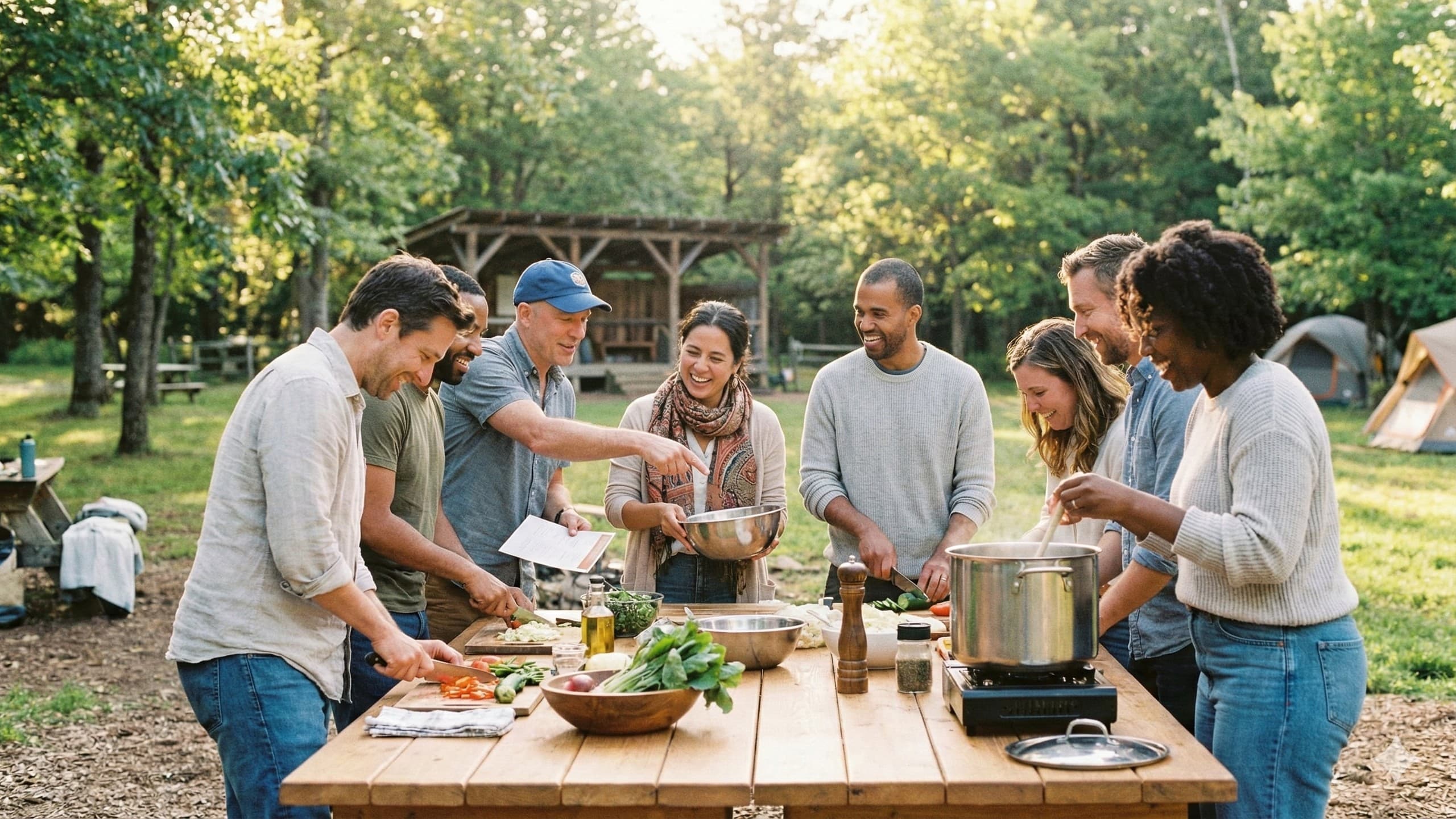
COOKING CHALLENGES
Format: Teams of 4–6 compete to prepare a dish within a time limit, often with a mystery ingredient twist. Professional chefs provide guidance and judging.
Why it works: Cooking requires planning, delegation, time management, and communication — all under pressure. It also produces a shared meal, which builds connection.
Budget: $75–$150 per person for a professional kitchen experience; $30–$60 per person for an in-office setup with catering support.
Team size: 10–60 people (multiple stations).
ART AND DESIGN WORKSHOPS
Options include: Collaborative mural painting, pottery, glass blowing, screen printing, cocktail making, floral arrangement, or improv comedy workshops.
Why it works: Creating something together builds a sense of shared accomplishment. Improv, in particular, develops listening skills, adaptability, and comfort with ambiguity — all directly transferable to work.
Budget: $40–$120 per person depending on the medium.
Team size: 8–40 people.
MUSIC AND PERFORMANCE
Format: Drum circles, band formation workshops (where teams learn and perform a song in a few hours), or songwriting challenges.
Why it works: Music requires real-time collaboration, active listening, and willingness to contribute without knowing the outcome. It is also genuinely fun, even for non-musicians.
Budget: $50–$100 per person.
Team size: 15–80 people.
Category 2: Adventure and Physical Activities
Physical team building creates memorable shared experiences through adrenaline and challenge. Important caveat: always offer alternative activities for team members with physical limitations.
ESCAPE ROOMS
Format: Teams of 4–8 solve puzzles and riddles to "escape" a themed room within a time limit (typically 60 minutes).
Why it works: Escape rooms surface team dynamics in real time — who leads, who listens, who gets frustrated, who sees patterns others miss. They are excellent for natural debriefing conversations about collaboration.
Budget: $30–$50 per person.
Team size: 8–40 people (multiple rooms running simultaneously).
OUTDOOR ADVENTURES
Options include: Ropes courses, hiking challenges, kayaking, rock climbing, go-karting, archery, or scavenger hunts in a local city.
Why it works: Shared physical challenges create strong bonds. Being outdoors also reduces stress and improves mood, making people more open to genuine connection.
Budget: $50–$200 per person depending on the activity.
Team size: 10–100+ people (scavenger hunts and hiking scale well).
SPORTS TOURNAMENTS
Format: Organize a mini-tournament in a low-skill-barrier sport — bowling, kickball, cornhole, ping pong, or volleyball. Mix teams across departments.
Why it works: Friendly competition builds energy and breaks down departmental silos when teams are deliberately mixed.
Budget: $20–$80 per person (venue rental, equipment, food and drinks).
Team size: 20–200+ people.
Category 3: Skill-Building Events
These activities blend professional development with team building, making them easier to justify to budget-conscious leadership.
HACKATHONS AND INNOVATION SPRINTS
Format: Cross-functional teams tackle a real business challenge in a compressed timeframe (typically 24–48 hours, though half-day versions work too). Teams pitch solutions to a panel of judges.
Why it works: Hackathons create real business value while building cross-functional relationships. They also identify hidden talent and creative thinkers.
Budget: $30–$80 per person (venue, food, prizes).
Team size: 20–200 people.
WORKSHOP SERIES
Format: Bring in an expert to teach a skill that is relevant to your team's work — public speaking, data visualization, design thinking, negotiation, storytelling, or leadership communication. Include collaborative exercises.
Why it works: People value learning opportunities. When the learning happens in teams, it builds both skills and relationships simultaneously.
Budget: $50–$150 per person (speaker fees, materials, venue).
Team size: 15–50 people per workshop.
INDUSTRY FIELD TRIPS
Format: Visit a company, factory, museum, or research facility relevant to your industry or business model. Tour, observe, and debrief as a group.
Why it works: Shared learning experiences create common reference points that improve future collaboration. Seeing how other organizations operate sparks fresh thinking.
Budget: $20–$60 per person (transportation, admission, meals).
Team size: 10–40 people.
Category 4: Social Impact Activities
Purpose-driven team building resonates deeply, especially with younger employees. A 2025 Deloitte survey found that 73% of millennials and Gen Z workers say they are more engaged when their employer supports community initiatives.
VOLUNTEER DAYS
Format: Partner with a local nonprofit for a day of service — building homes with Habitat for Humanity, cleaning up a park or beach, serving meals at a shelter, or tutoring students.
Why it works: Working together for a cause larger than the company builds genuine pride and connection. It also demonstrates corporate values in action.
Budget: $10–$30 per person (transportation, T-shirts, meals).
Team size: 15–200+ people.
BUILD-A-KIT CHALLENGES
Format: Teams compete to assemble care kits (hygiene kits, school supply kits, emergency kits) for a charitable organization. Often combined with a trivia or challenge element.
Why it works: It is competitive, fast-paced, and produces a tangible result that benefits real people.
Budget: $30–$60 per person (kit materials, facilitation).
Team size: 20–500 people (scales exceptionally well).
FUNDRAISING COMPETITIONS
Format: Divide into teams and challenge each group to raise the most money for a selected charity within a set timeframe. Teams create campaigns, leverage social networks, and present their results.
Why it works: It develops marketing, collaboration, and presentation skills while supporting a cause.
Budget: $0–$20 per person (minimal logistics).
Team size: 10–100 people.
Category 5: Virtual-Friendly Team Building
For remote and distributed teams, virtual team building requires more creativity but can be equally effective when done well.
VIRTUAL ESCAPE ROOMS AND MURDER MYSTERIES
Format: Online versions of escape rooms or detective games, facilitated by a professional host. Teams collaborate via video call to solve the challenge.
Budget: $20–$40 per person.
Team size: 6–50 people (breakout groups of 4–8).
REMOTE COOKING OR COCKTAIL CLASSES
Format: A professional chef or mixologist leads the session via video. Ingredient kits are shipped to participants in advance.
Budget: $50–$100 per person (including shipped ingredients).
Team size: 10–50 people.
SHOW AND TELL OR TALENT SHOWS
Format: Team members volunteer to share a hobby, skill, or passion project. Three to five minutes per person, followed by Q&A.
Budget: $0.
Team size: 8–30 people.
ONLINE GAME TOURNAMENTS
Format: Organized tournaments in accessible games — trivia platforms (like Kahoot), Jackbox Games, Among Us, or Pictionary-style drawing games.
Budget: $0–$15 per person (game licenses).
Team size: 10–100 people.
Matching Activity to Team Size and Goals
Not every activity works for every situation. Use this decision framework:
Goal: Build trust | Small Team (5–15): Escape room, cooking challenge | Medium Team (15–50): Ropes course, workshop | Large Team (50+): Volunteer day, scavenger hunt
Goal: Improve communication | Small Team (5–15): Improv workshop, hackathon | Medium Team (15–50): Innovation sprint, field trip | Large Team (50+): Build-a-kit challenge, sports tournament
Goal: Break down silos | Small Team (5–15): Cross-team cooking competition | Medium Team (15–50): Mixed-department hackathon | Large Team (50+): Company-wide tournament or scavenger hunt
Goal: Boost morale | Small Team (5–15): Dinner outing, show and tell | Medium Team (15–50): Concert or sporting event | Large Team (50+): Annual celebration, destination activity
Goal: Welcome new hires | Small Team (5–15): Small group activity + lunch | Medium Team (15–50): Buddy system + team challenge | Large Team (50+): Orientation event with mixed teams
Planning Your Team Building Event: A Timeline
4–6 weeks out:
• Define the objective (what should improve after this event?)
• Survey the team on activity preferences (give three to four options, let them vote)
• Set budget and get approval
• Research and book vendors or venues
2–3 weeks out:
• Confirm logistics (venue, transportation, catering, materials)
• Send invitations with clear details (what to wear, what to expect, any physical requirements)
• For virtual events, ship any physical materials
• Set up attendee tracking and team assignments
1 week out:
• Send reminder with final details
• Confirm all vendor arrangements
• Prepare any materials or presentations
• Brief facilitators or team leaders
Day of:
• Arrive early to set up and test everything
• Welcome the team and set expectations (this is optional for participation, not observation)
• Facilitate the activity with energy and flexibility
• Close with a brief reflection or debrief
Post-event:
• Send a thank-you message and photos within 24 hours
• Survey the team for feedback (keep it to 3–5 questions)
• Share results and learnings with leadership
• Plan the next one based on feedback
Measuring the Impact of Team Building
Team building ROI is real, but it requires the right metrics:
• Employee NPS — survey before and after (target a 5–10 point lift)
• Engagement pulse scores — track in your next regular engagement survey
• Cross-functional collaboration — measure project collaborations across departments
• Voluntary turnover — track in the quarter following a sustained team building program
• Team communication frequency — measure Slack/Teams interaction between team members who attended together
Coordinating Multi-Activity Events
For larger teams or events with multiple activity options, logistics become the biggest challenge. You need to track which team members are assigned to which activities, manage different venues or time slots, and ensure everyone has the information they need.
Eventifia's sub-event tracking lets you manage multi-activity events within a single platform — creating separate sessions for each activity, assigning attendees to specific groups, and tracking participation across the entire experience. Instead of juggling spreadsheets and group texts, your coordination team has a single real-time view of where everyone is and what is happening next.
Make Team Building Worth Everyone's Time
The bar for corporate team building is higher than ever. Your team has seen the forced-fun playbook, and they are not interested in a repeat performance.
The good news: when you match the right activity to the right team with the right objectives, team building creates genuine value — stronger relationships, better communication, higher morale, and measurable business impact.
Choose activities that respect your team's time and intelligence. Give people options. Follow through on what you learn. And use the right tools to coordinate the logistics so the experience feels seamless.
Explore how Eventifia can help you plan and manage team building events of any size at eventifia.com — from a 10-person cooking challenge to a 500-person company-wide day of service.