Sustainable Corporate Events: A Practical Guide to Green Planning
Plan sustainable corporate events with this practical guide covering green venues, zero-waste catering, digital alternatives, and carbon measurement.
February 24, 202610 min read
Introduction
Sustainability in corporate events has shifted from a feel-good differentiator to a baseline expectation. In a 2025 MeetGreen industry survey, 84% of attendees said they consider an event organizer's sustainability practices when deciding whether to attend. Among corporate sponsors and partners, 71% now include environmental criteria in their sponsorship evaluation process.
The shift is not purely altruistic. Regulatory pressure is mounting — the European Union's Corporate Sustainability Reporting Directive now requires companies above certain thresholds to report on event-related emissions. The SEC's climate disclosure rules, while still evolving in the United States, are pushing publicly traded companies to quantify and reduce Scope 3 emissions, which include business travel and events. Even in the absence of regulation, stakeholders — investors, customers, employees, and partners — are watching.
But here is the good news for event planners: sustainable events are not more difficult or more expensive than conventional events. In many cases, they are cheaper. The Event Industry Council's 2025 Sustainability Report found that events implementing comprehensive green practices save an average of 20–30% on print, waste disposal, and material costs.
This guide provides a practical, actionable framework for planning sustainable corporate events — not as a marketing exercise, but as a smarter way to operate.
The Sustainable Event Framework
Sustainability touches every aspect of event planning. Rather than tackling it as a separate initiative, integrate it into your standard planning process across six domains.
DOMAIN 1: VENUE SELECTION
Your venue choice is the single highest-impact sustainability decision you will make. It determines energy consumption, transportation emissions, waste infrastructure, and catering sourcing options.
What to look for:
• LEED or BREEAM certification — these internationally recognized standards ensure the building meets rigorous environmental criteria for energy efficiency, water conservation, and indoor environmental quality. A LEED-certified venue reduces your event's energy footprint by 25–40% compared to a conventional building.
• Transit accessibility — venues accessible by public transportation, walking, or cycling reduce attendee travel emissions dramatically. A venue near a major transit hub can reduce transportation-related carbon by 50–70% compared to a venue requiring car or shuttle access.
• Renewable energy — ask if the venue sources electricity from renewable sources (solar, wind, or purchased renewable energy credits). An increasing number of convention centers and hotels now operate on 100% renewable electricity.
• On-site waste management — does the venue have recycling, composting, and waste diversion programs? What is their current waste diversion rate? (Industry benchmark: 60%+ is good, 80%+ is excellent.)
• Water conservation — low-flow fixtures, rainwater harvesting, and water-efficient landscaping indicate environmental commitment.
• Local ownership and community impact — choosing locally owned venues keeps economic benefits in the community and often supports more sustainable operations.
Questions to ask venue operators:
1. What is your current waste diversion rate?
2. Do you source energy from renewable sources?
3. Do you have composting capability for food waste?
4. What sustainability certifications do you hold?
5. Can you provide an environmental impact report for our event?
DOMAIN 2: CATERING AND FOOD SERVICE
Food is typically the largest waste stream at corporate events. The Natural Resources Defense Council estimates that events generate 15–25% food waste by weight — enough to represent both an environmental and financial drain.
Sustainable catering principles:
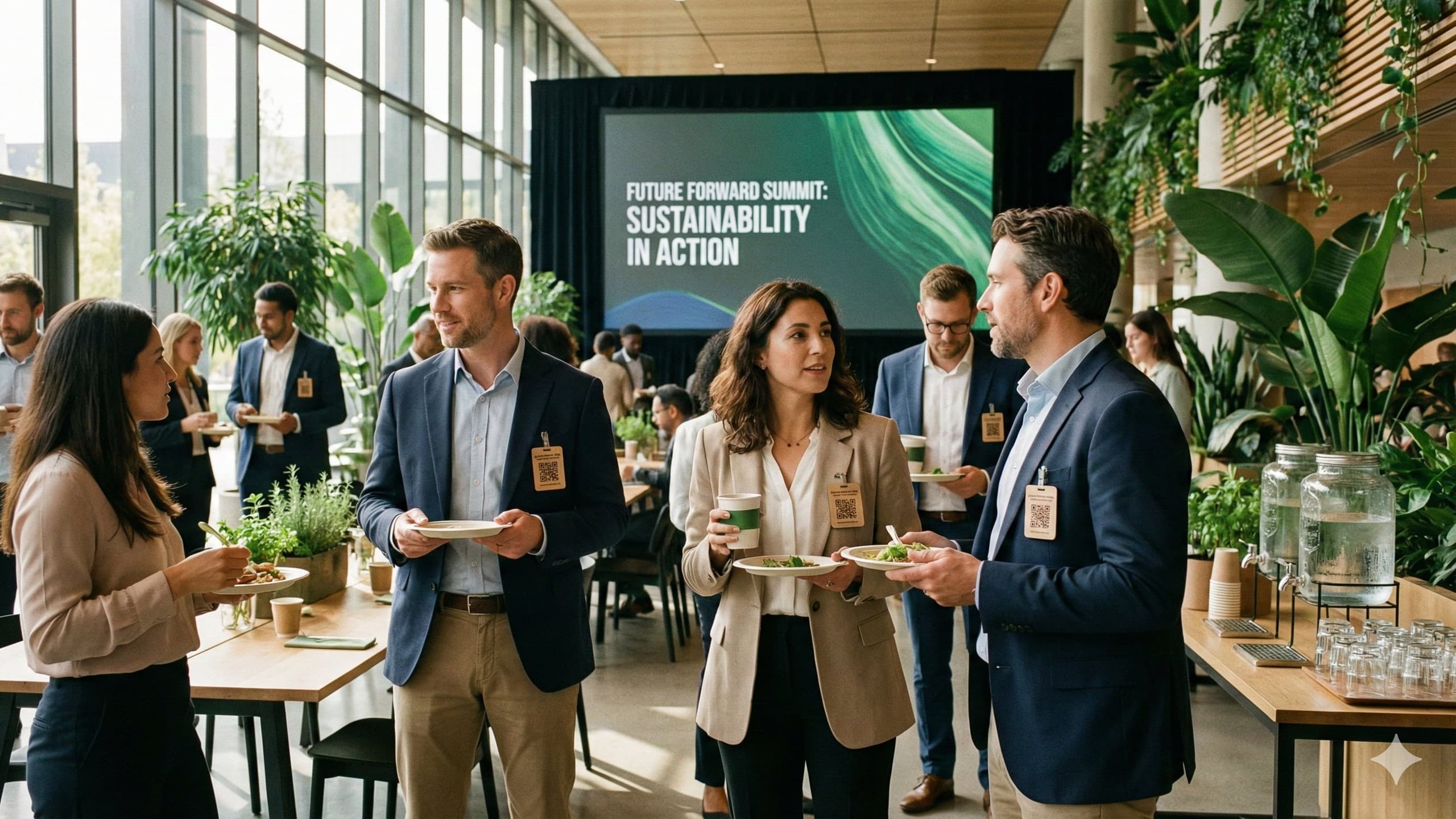
Source locally and seasonally. Food sourced within 100 miles of the venue reduces transportation emissions and supports local agriculture. Seasonal menus use ingredients at their peak, which means better flavor and lower environmental impact. Ask your caterer what percentage of ingredients are sourced locally.
Design plant-forward menus. Animal agriculture accounts for approximately 14.5% of global greenhouse gas emissions, according to the Food and Agriculture Organization of the United Nations. You do not need to eliminate meat entirely — but designing menus where plant-based dishes are the default (with meat as an opt-in option) can reduce your food-related carbon footprint by 30–50%.
Right-size portions. Work with your caterer to calibrate portions based on actual consumption data, not worst-case buffet planning. Build a 5–10% food buffer instead of the traditional 15–20%. Donate surplus food to a local food bank — organizations like Feeding America coordinate same-day food rescue.
Eliminate single-use plastics. Use real plates, glasses, and cutlery. If disposables are necessary (outdoor events, very large gatherings), choose compostable alternatives made from plant-based materials, not conventional plastic.
Implement zero-waste stations. Replace single-stream trash cans with clearly labeled sorting stations: compost, recycling, and landfill. Station trained volunteers or staff at sorting stations during peak times — proper sorting rates increase by 50–80% when someone is available to guide attendees.
Water service. Replace individual plastic water bottles with water refill stations. Provide reusable cups or encourage attendees to bring their own. A 500-person conference that eliminates bottled water prevents approximately 1,500–2,000 plastic bottles from entering the waste stream.
DOMAIN 3: MATERIALS AND COMMUNICATIONS
The traditional corporate event generates staggering amounts of printed material: programs, agendas, name badges, brochures, handouts, signage, and promotional materials. Most of it ends up in the trash within 24 hours.
Go digital first.
• Replace printed programs with a mobile event app or digital agenda
• Use digital signage instead of printed banners and posters (many venues offer digital display infrastructure)
• Send invitations, confirmations, and updates via email rather than printed mailers
• Provide digital business cards or QR-code-based contact sharing instead of printed cards
• Offer presentation materials as downloadable PDFs rather than printed handouts
When print is necessary:
• Use FSC-certified (Forest Stewardship Council) paper from sustainably managed forests
• Print with soy or vegetable-based inks
• Design materials for reuse (undated signage that can be used across multiple events)
• Print only what you need — avoid the "just in case" overprint that leads to boxes of unused materials
Swag rethinking. Corporate event swag has one of the worst environmental profiles in the events industry. A 2025 PPAI study found that 60% of promotional products are discarded within six months. Consider these alternatives:
• Skip swag entirely and donate the budget to a charity on attendees' behalf
• Offer a digital gift (charitable donation in their name, premium app subscription, digital content library)
• If physical gifts are expected, choose high-quality, useful items made from sustainable materials (premium reusable water bottles, organic cotton items, locally made products)
Eventifia's digital communications and paperless RSVP system eliminate the need for printed invitations, response cards, and attendee lists — replacing paper-intensive correspondence with streamlined digital workflows. For organizations managing multiple events per year, this alone prevents thousands of pages of printed material from entering the waste stream.
DOMAIN 4: TRAVEL AND TRANSPORTATION
Attendee travel is typically the largest source of carbon emissions for any corporate event — often accounting for 70–90% of the total carbon footprint.
Strategies to reduce travel emissions:
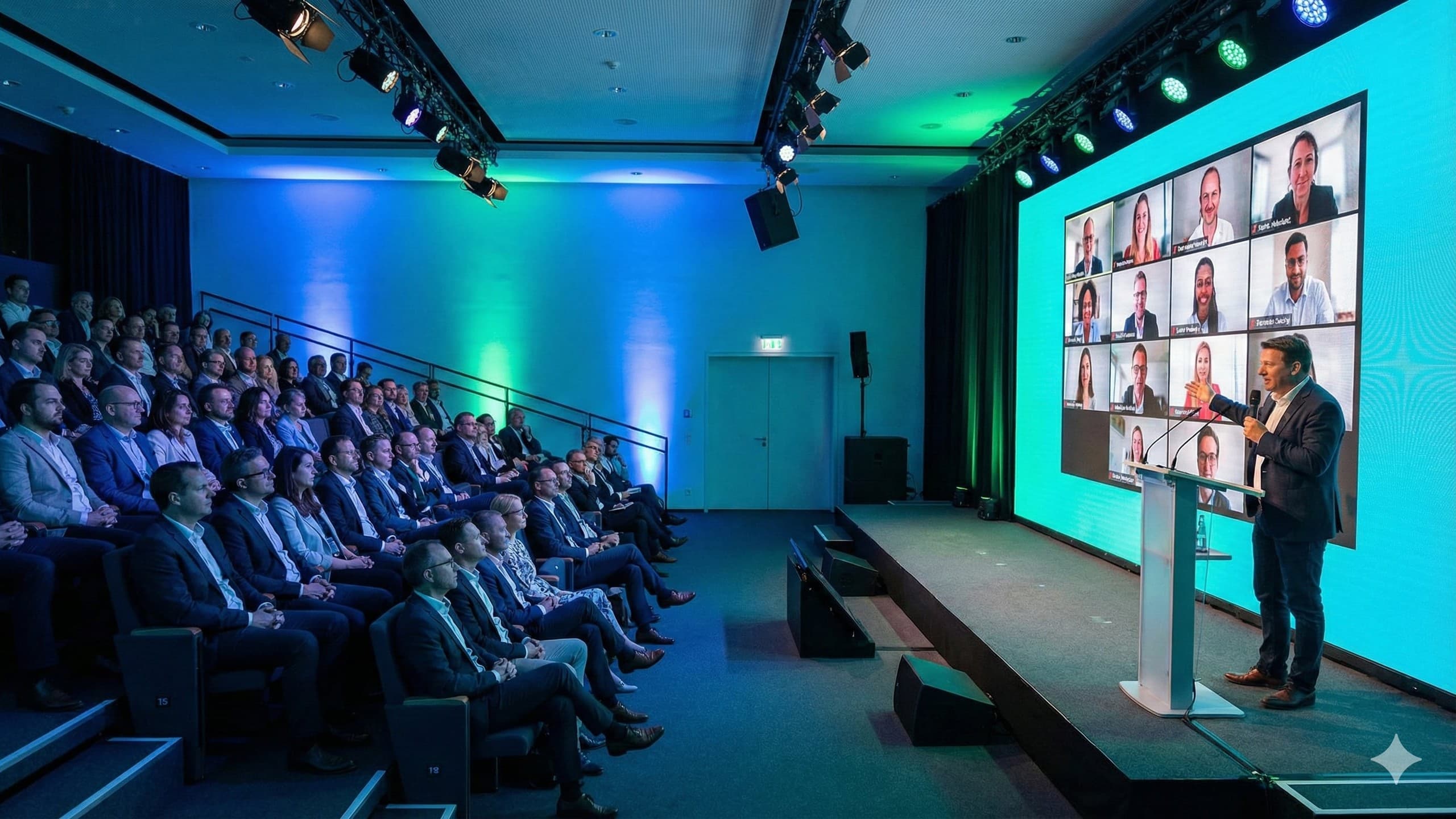
Offer a virtual attendance option. Even if your event is primarily in-person, providing a high-quality virtual track allows attendees to participate without travel. A 2025 ICCA study found that offering a virtual option reduces travel-related emissions by 25–40% while expanding total audience reach.
Choose venue locations strategically. If most of your attendees are in one geographic region, locate the event there rather than choosing a "destination" location that requires flights.
Coordinate group transportation. Arrange shuttle service from airports and hotels to the venue. Group transportation reduces per-person emissions and eases parking congestion.
Provide transit information proactively. Include public transportation directions, bike-share locations, and walking routes in attendee communications. Make the sustainable option the easy option.
Implement carbon offsets. For emissions that cannot be eliminated, purchase verified carbon offsets through reputable registries (Gold Standard, Verified Carbon Standard, or American Carbon Registry). Calculate travel emissions using tools like the ICAO carbon calculator for flights and EPA emission factors for ground transportation.
Budget expectation: carbon offsets cost approximately $10–$30 per metric ton of CO2, which translates to roughly $5–$20 per attendee for a typical domestic conference.
DOMAIN 5: WASTE MANAGEMENT
The average conference attendee generates 4.4 pounds of waste per day, according to the EPA. For a 500-person, two-day conference, that is 4,400 pounds of waste — most of which is avoidable.
The waste hierarchy for events:
1. Prevent — eliminate unnecessary materials, right-size food orders, avoid over-ordering
2. Reduce — minimize packaging, use concentrated cleaning products, choose bulk over individual servings
3. Reuse — use durable signage, lanyards, and badge holders that can be used across events; collect and redistribute unused materials
4. Recycle — ensure comprehensive recycling infrastructure with clear signage
5. Compost — divert food waste and compostable materials from landfill
6. Landfill — the last resort for materials that cannot be prevented, reused, recycled, or composted
Specific waste reduction tactics:
• Implement a lanyard and badge collection station at the exit — collected lanyards can be reused at future events (savings: $1–$3 per lanyard multiplied by hundreds of attendees)
• Replace individual condiment packets with bulk dispensers at food stations
• Provide water refill stations instead of bottled water
• Use digital check-in instead of printed attendee lists
• Negotiate with vendors to minimize packaging in deliveries
DOMAIN 6: ENERGY AND TECHNOLOGY
• Use LED lighting throughout the event (LEDs consume 75% less energy than incandescent alternatives)
• Power down AV equipment during breaks and after sessions
• Choose cloud-based event technology over on-premise servers (cloud data centers are increasingly powered by renewable energy)
• If outdoor generators are needed, request biodiesel or hybrid units
• Use natural lighting where possible to reduce artificial lighting needs
Measuring and Reporting Environmental Impact
What gets measured gets managed. Quantify your event's environmental impact using these metrics:
CARBON FOOTPRINT CALCULATION
Track emissions across three scopes:
• Scope 1 (direct emissions): On-site fuel combustion (generators, cooking gas)
• Scope 2 (energy indirect): Electricity consumption at the venue
• Scope 3 (other indirect): Attendee travel, hotel stays, catering supply chain, material production and transportation
For most events, Scope 3 (particularly attendee travel) accounts for the vast majority of emissions. Use sector-specific emission factors from the GHG Protocol, EPA, or DEFRA to calculate.
WASTE METRICS
• Total waste generated (weight in pounds or kilograms)
• Waste diversion rate — percentage of waste diverted from landfill through recycling, composting, and reuse. Target: 70%+
• Per-attendee waste — total waste divided by number of attendees. Target: under 2 pounds per person per day
WATER METRICS
• Total water consumption (gallons)
• Per-attendee water consumption
• Percentage reduction from baseline or previous event
REPORTING
Create a post-event sustainability report that includes:
• Total carbon footprint (broken down by scope)
• Waste metrics and diversion rates
• Specific sustainable practices implemented
• Cost comparison with conventional alternatives
• Recommendations for improvement at future events
Share this report with stakeholders, sponsors, and attendees. Transparency builds credibility and demonstrates genuine commitment.
Certifications and Standards
ISO 20121: EVENT SUSTAINABILITY MANAGEMENT SYSTEMS
ISO 20121 is the international standard for sustainable event management. Developed after the 2012 London Olympics, it provides a framework for integrating sustainability into every stage of event planning, delivery, and follow-up.
Achieving ISO 20121 certification signals serious commitment and provides a structured approach to continuous improvement. The certification process typically takes 6–12 months and costs $5,000–$20,000 depending on organization size and event complexity.
OTHER RELEVANT CERTIFICATIONS
• Green Key — venue-level environmental certification recognized in over 65 countries
• APEX/ASTM Environmentally Sustainable Meeting Standards — industry-specific standards for nine areas of event management
• EIC Sustainability Certificate — offered by the Events Industry Council, a professional development certification for event planners
The Cost Reality: Green Does Not Always Cost More
One of the most persistent myths about sustainable events is that they cost significantly more. The reality is more nuanced:
Areas where sustainability saves money:
• Eliminating printed materials ($2,000–$10,000+ savings for a 500-person conference)
• Reducing food waste through right-sized ordering (10–15% savings on catering)
• Using digital communications instead of mailed invitations ($1,000–$5,000 savings)
• Reusing signage and materials across events (20–30% savings on production over time)
• Reducing energy consumption through LED lighting and efficient equipment (5–15% savings on AV costs)
Areas where sustainability adds cost:
• Carbon offsets ($5–$20 per attendee)
• Premium sustainable catering ingredients (5–15% increase)
• Compostable disposables vs. standard plastic (10–20% increase)
• Sustainability consulting or certification ($5,000–$20,000)
Net impact: For most events, the savings from waste reduction, digital communications, and material elimination offset or exceed the additional costs of sustainable alternatives. The Event Industry Council reports a net average savings of 10–15% for events implementing comprehensive sustainability programs.
Building a Sustainable Event Program Over Time
Sustainability is not a one-event initiative. Build a multi-year improvement plan:
Year 1: Foundation
• Establish baseline measurements for carbon, waste, and resource consumption
• Implement the highest-impact, lowest-cost changes (digital communications, waste sorting, local catering)
• Set targets for Year 2
Year 2: Acceleration
• Implement carbon offset program for attendee travel
• Achieve 70%+ waste diversion rate
• Negotiate sustainability clauses in all vendor contracts
• Begin working toward ISO 20121 or equivalent certification
Year 3: Leadership
• Achieve carbon-neutral event status (through reduction + offsets)
• Publish comprehensive sustainability reports
• Share best practices with industry peers
• Set science-based targets aligned with 1.5-degree climate goals
Communicating Sustainability to Attendees
How you communicate your sustainability efforts matters as much as the efforts themselves.
Do:
• Be transparent about what you are doing and what you are not doing yet
• Provide specific data and metrics, not vague claims
• Make sustainable choices easy and obvious for attendees (clear signage at sorting stations, convenient refill stations, prominent transit information)
• Invite attendee participation and feedback on sustainability initiatives
• Acknowledge that sustainability is a journey and share your improvement targets
Do not:
• Greenwash — exaggerate your efforts or make claims you cannot substantiate
• Be preachy — sustainability messaging should be informative, not condescending
• Make sustainability inconvenient — if the sustainable option requires significantly more effort, people will not choose it
• Ignore the basics while highlighting the flashy — attendees will notice if you are promoting carbon offsets while serving every meal with plastic utensils
Practical Sustainability Checklist
Use this checklist for your next event:
Venue
☐ LEED, BREEAM, or equivalent certification
☐ Accessible by public transportation
☐ Renewable energy sourcing
☐ On-site recycling and composting
Catering
☐ Local and seasonal sourcing (minimum 50% of ingredients)
☐ Plant-forward menu design
☐ Right-sized portions with food donation plan for surplus
☐ No single-use plastics
☐ Water refill stations instead of bottled water
Materials
☐ Digital-first communications and registration
☐ Printed materials on FSC-certified paper with soy inks (when print is necessary)
☐ Sustainable or no swag
☐ Reusable signage and branding
Travel
☐ Virtual attendance option
☐ Group transportation from airports/hotels
☐ Transit information in attendee communications
☐ Carbon offset program for attendee travel
Waste
☐ Clearly labeled sorting stations (compost, recycling, landfill)
☐ Trained volunteers at sorting stations during peak times
☐ Lanyard and badge collection for reuse
☐ Target waste diversion rate of 70%+
Energy
☐ LED lighting throughout
☐ Equipment powered down during breaks
☐ Natural lighting utilized where possible
Measurement
☐ Carbon footprint calculated (all three scopes)
☐ Waste metrics tracked (total waste, diversion rate, per-attendee)
☐ Post-event sustainability report published
Sustainability Starts with Smarter Systems
Every paperless RSVP, every digital communication, every eliminated print run represents a small but measurable step toward more sustainable events. Eventifia's digital-first approach to event management — from online registration and digital attendee communications to paperless check-in and real-time reporting — eliminates the paper-heavy processes that have defined event management for decades.
But tools are just one part of the equation. Sustainable events require intentional decisions at every stage of planning, from venue selection to post-event waste measurement. Use this guide as your framework, measure your impact, and improve with every event.
Start planning sustainable events with Eventifia at eventifia.com — and prove that operational excellence and environmental responsibility go hand in hand.