Destination Wedding Planning: Everything You Need to Know in 2026
Plan your dream destination wedding with our complete 2026 guide. Covers legal requirements, budgets, guest communication, and multi-day event management.
February 24, 202612 min read
Introduction
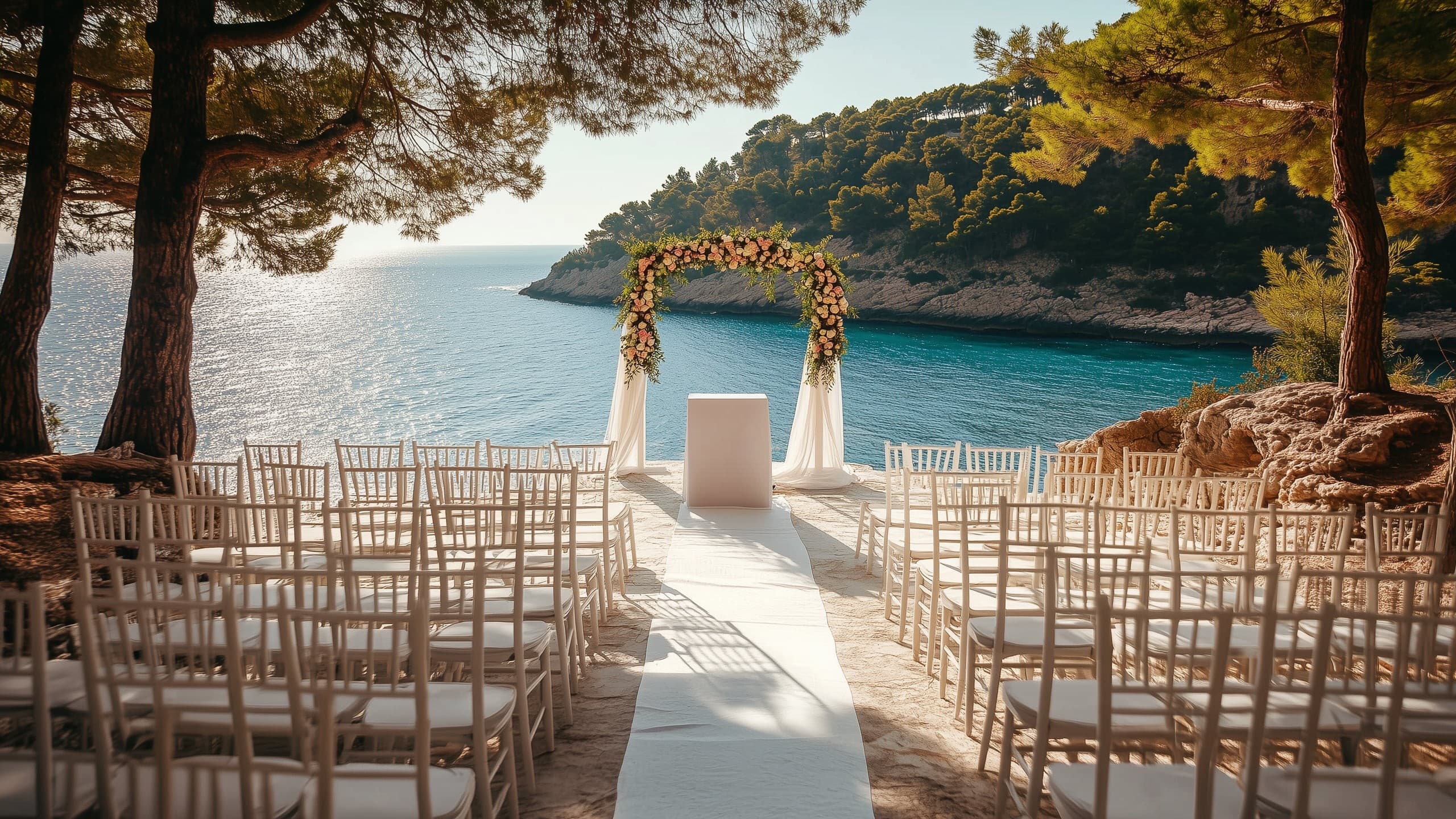
There is a moment during every destination wedding when the couple looks around — at the Mediterranean sunset behind them, the vineyard stretching to the horizon, or the turquoise water lapping at a white sand shore — and realizes that this is exactly why they chose to do it this way. Not in a hotel ballroom back home. Not in the church their parents were married in. Here, in a place that means something to them, surrounded by the people who loved them enough to cross an ocean.
Destination weddings in 2026 represent approximately 25% of all weddings, according to data from The Knot. That number has grown consistently over the past decade as couples prioritize experience over convention and as remote work has made many guests more flexible with travel. The average destination wedding in 2026 costs between $25,000 and $50,000, depending on location, guest count, and the scope of events — but that range obscures enormous variation. A 30-person wedding in Mexico's Riviera Maya looks very different financially from a 120-person celebration in the Amalfi Coast.
Whether you are dreaming of a Tuscan villa, a Costa Rican rainforest, or a Scottish castle, this guide covers everything you need to plan a destination wedding that is logistically sound, financially realistic, and deeply memorable.
Choosing the Right Destination
Your location decision should balance five factors: personal meaning, guest accessibility, legal feasibility, weather reliability, and budget alignment.
PERSONAL MEANING
The best destination weddings happen in places that have genuine significance to the couple. Where you took your first trip together. The country one of you calls home. The place you got engaged. A location connected to your shared interests (wine country for wine lovers, a ski resort for mountain enthusiasts). Generic "pretty places" from Pinterest can feel hollow if there is no personal connection.
GUEST ACCESSIBILITY
This is the factor couples most often underestimate. If your guest list includes elderly grandparents, friends with young children, or people with limited travel budgets, a remote island accessible only by a puddle-jumper requires those guests to clear significantly higher logistical hurdles than a popular destination with direct flights.
Consider:
• How many direct flights serve the destination from where most of your guests live?
• What is the passport and visa situation? (Some guests may not have passports.)
• Is the destination accessible for guests with mobility issues?
• What is the typical travel cost, including flights and accommodations?
A rule of thumb: the harder your destination is to reach, the smaller your guest count will be. If you want 100 people at your wedding in Bali, be prepared for significant attrition. If you want a guaranteed high turnout, choose a destination within a 3-4 hour flight for most guests.
LEGAL REQUIREMENTS BY POPULAR DESTINATION
Legal marriage requirements vary dramatically by country, and getting this wrong can mean your wedding is not legally recognized. Here are the 2026 requirements for some of the most popular destinations:
Mexico: Requires blood tests, birth certificates, and four witnesses. Documents must be translated to Spanish by an official translator. Processing takes about 3-4 business days. Many couples do a legal civil ceremony at home and a symbolic ceremony in Mexico to avoid the paperwork.
Italy: Requires a Nulla Osta (declaration that you are free to marry) from your home country's consulate in Italy. The process takes 2-4 weeks and involves multiple appointments. Start this paperwork at least 2 months before your trip.
France: One of the most complex. At least one partner must be a resident for 40 consecutive days before the ceremony. Most international couples marry legally at home and hold a symbolic ceremony in France.
Costa Rica: Surprisingly straightforward. A local lawyer can facilitate the legal paperwork, and there is no residency requirement. Documents take about a week to process.
Greece: Requires several documents including birth certificates, passport copies, and an affidavit of single status. Processing takes 1-2 weeks. The ceremony must be performed by a mayor (civil) or a Greek Orthodox priest (religious).
Caribbean Islands (general): Most Caribbean destinations have relatively simple requirements, though they vary by island. Many require a minimum stay of 24-48 hours before the ceremony. Jamaica, the Bahamas, and the U.S. Virgin Islands are among the easiest.
Recommendation: Research legal requirements at least 12 months before your wedding. Many couples choose to have a small legal ceremony at home and a larger symbolic ceremony at their destination, simplifying the process significantly.
The Destination Wedding Timeline
Start earlier than you think. A destination wedding needs 14-18 months of planning, compared to 10-14 months for a local wedding. The additional time accounts for long-distance vendor coordination, travel logistics, and the extended communication timeline your guests need.
18-14 MONTHS OUT
• Choose your destination and research legal requirements
• Visit the location (ideally) or schedule extensive video tours
• Hire a local wedding planner or coordinator (this is not optional for destination weddings)
• Book your venue
• Set your budget, including a line item for travel costs you will cover (your own, potentially your parents', and sometimes your wedding party's)
12-10 MONTHS OUT
• Send save-the-dates (guests need maximum lead time for booking flights)
• Reserve hotel room blocks at 2-3 price points
• Book your photographer (local photographers know the light, the angles, and the backup locations — prioritize local over flying someone in)
• Begin coordinating with your planner on vendor recommendations (florist, caterer, musician, officiant)
8-6 MONTHS OUT
• Send formal invitations with complete travel information
• Create a detailed wedding website with travel guides, accommodation options, activity suggestions, and a packing guide
• Plan welcome bags with local treats and a printed weekend itinerary
• Finalize your multi-day event schedule
• Book any group activities (boat tour, wine tasting, group dinner)
4-2 MONTHS OUT
• Confirm all vendor contracts and timelines
• Track RSVPs and follow up with non-responders
• Finalize your seating chart and event details
• Ship or arrange transport for any items you are bringing from home (dress, decor, personal items)
• Confirm your own travel arrangements
1 MONTH OUT
• Final confirmation with all vendors and your planner
• Prepare day-of timeline and distribute to everyone involved
• Prepare vendor payments (research tipping customs in your destination country)
• Pack thoughtfully — bring essentials in your carry-on, not your checked luggage
Budgeting for a Destination Wedding
Destination wedding budgets are structured differently from local weddings. Some costs decrease (guest count is typically 40-60% of a local wedding, reducing per-head expenses), while others increase (travel, multi-day events, planner coordination fees).
TYPICAL BUDGET BREAKDOWN
Category: Venue and catering | Percentage: 35-45% | Notes: Often bundled at destination venues
Category: Travel and accommodations (couple) | Percentage: 10-15% | Notes: Flights, hotel for extended stay
Category: Photography and videography | Percentage: 8-12% | Notes: Local photographers recommended
Category: Flowers and decor | Percentage: 8-10% | Notes: Local flowers often less expensive
Category: Music and entertainment | Percentage: 5-8%
Category: Wedding planner | Percentage: 8-12% | Notes: Higher percentage due to coordination complexity
Category: Stationery and communication | Percentage: 2-3%
Category: Welcome events and activities | Percentage: 5-10% | Notes: Welcome dinner, group outings
Category: Miscellaneous and buffer | Percentage: 5-8% | Notes: Currency fluctuation, unexpected costs
WHAT COUPLES TYPICALLY COVER VS. WHAT GUESTS COVER
A clear, common question: who pays for what?
The couple typically covers:
• All wedding event costs (ceremony, reception, welcome dinner, farewell brunch)
• Welcome bags
• Group transportation between events
• Their own travel and extended accommodations
Guests typically cover:
• Their own flights
• Their own hotel accommodations
• Their own meals outside of wedding events
• Personal activities and excursions
It is generous but not expected to cover:
• Guest hotel rooms (some couples cover one night, some cover the full stay for close family)
• Group excursions or activities
• Airport transfers
Be transparent about costs early. Your save-the-date or a follow-up communication should include estimated travel costs so guests can plan financially.
Managing the Multi-Day Experience
A destination wedding is almost never a single-event affair. Guests have traveled a great distance, and the celebration typically spans 2-4 days. Managing this extended schedule requires detailed communication and careful logistics.
THE TYPICAL DESTINATION WEDDING SCHEDULE
Day 1 (Arrival Day): Welcome drinks or casual dinner. Keep it low-key — guests are arriving at different times and may be jet-lagged. A pool party, beach barbecue, or casual restaurant reservation works well.
Day 2 (Activity Day): An optional group activity — wine tour, snorkeling, city walking tour, cooking class. Offer it but do not require it. Some guests want to explore on their own or simply relax.
Day 3 (Wedding Day): The ceremony, cocktail hour, and reception. This is the main event and should be planned with the same detail as any wedding. Include buffer time for hair, makeup, and photography.
Day 4 (Farewell): A morning-after brunch or farewell gathering. Keep it short and sweet — people have flights to catch and hangovers to manage.
COMMUNICATION IS EVERYTHING
Your guests need more information for a destination wedding than a local one, and they need it earlier. Your wedding website should function as a comprehensive travel guide:
• Travel logistics: Airport information, recommended airlines, group transfer arrangements
• Accommodation options: Your room block details plus alternative hotels and vacation rentals at different price points
• Packing suggestions: Climate, dress codes for each event, comfortable shoes for cobblestone streets
• Weekend schedule: A clear timeline of all events with locations, dress codes, and whether attendance is optional
• Local tips: Currency, tipping customs, useful phrases in the local language, restaurant recommendations, safety information
This volume of information makes a digital-first communication strategy essential. Managing RSVPs for multiple events across a multi-day celebration — while some guests attend everything and others only the wedding day — requires a system that tracks attendance by event, not just by name.
Eventifia is designed for exactly this kind of multi-event complexity. You can create your destination wedding as a single project with separate sub-events (welcome dinner, ceremony, reception, farewell brunch), each with its own guest list and RSVP tracking. When a guest RSVPs yes to the ceremony and reception but no to the welcome dinner, that information is tracked automatically. When you need to tell the welcome dinner restaurant how many guests to expect, the number is one click away. For destination weddings, where you are coordinating across time zones with vendors who speak a different language, this level of organization is not a luxury.
Common Destination Wedding Mistakes to Avoid
Skipping the site visit. Planning a wedding entirely through photos and video calls is risky. Lighting looks different in person. The "garden ceremony" site might be next to a noisy road. The suite you wanted for getting ready might be a 15-minute walk from the ceremony. If at all possible, visit your venue before committing.
Underestimating local customs. In some countries, weddings end by a certain hour due to noise ordinances. In others, tipping is offensive. In some, vendors do not respond to emails promptly because business culture prioritizes phone calls or in-person meetings. Your local planner is your bridge to understanding these nuances.
Planning too many events. Three to four events across a long weekend is the sweet spot. More than that, and guests feel obligated and exhausted rather than celebratory. Give people free time to enjoy the destination on their own terms.
Neglecting the guest experience. It is easy to focus exclusively on the wedding day and forget that your guests are spending significant money and vacation days to be there. A thoughtful welcome bag, clear communication, and optional (not mandatory) group activities show that you value their effort.
Forgetting about weather contingencies. An outdoor ceremony in the Caribbean in September is a gamble. Always have a rain plan, and make sure your venue contract specifies what happens if weather forces a change.
Making It Legal from Afar
If you choose to have a legal ceremony at home and a symbolic ceremony at your destination, plan the legal ceremony as a meaningful moment, not a bureaucratic errand. Many couples turn their legal ceremony into an intimate experience — just the two of them at city hall, or with their parents and witnesses at a favorite local restaurant. Treat it as the first chapter of your wedding story, not the fine print.
Bring a certified copy of your marriage certificate to your destination, as some vendors, hotels, or traditions may reference your legal marriage status.
Your Destination Wedding Planning Checklist
☐ Research and choose your destination (consider meaning, accessibility, legality, weather, budget)
☐ Hire a local wedding planner or coordinator
☐ Visit the venue in person if possible
☐ Understand and begin legal marriage requirements
☐ Send save-the-dates 12+ months in advance
☐ Book venue, photographer, and priority vendors
☐ Reserve hotel room blocks at multiple price points
☐ Build a comprehensive wedding website with travel information
☐ Send invitations 8-6 months in advance
☐ Plan welcome event, optional group activities, and farewell brunch
☐ Track RSVPs by sub-event
☐ Prepare welcome bags with local items and weekend itinerary
☐ Confirm all vendors 4-6 weeks before travel
☐ Prepare vendor payments in local currency
☐ Ship or transport necessary items
☐ Finalize day-of timeline with local planner
☐ Breathe. You are getting married in an incredible place.
Final Thoughts
A destination wedding is an invitation to adventure — for you and for every person who accepts it. Your guests will remember not just the ceremony, but the sunset they watched from the hotel terrace, the dinner at the tiny restaurant your planner recommended, the morning swim before the farewell brunch. You are not just hosting a wedding. You are creating a shared travel experience bound together by your love story.
The logistics are real, and they are more complex than a local wedding. But with the right timeline, the right local planner, and the right systems in place, every piece falls into position. And when you stand in front of the person you love in a place that takes your breath away, every spreadsheet, every timezone-crossing phone call, and every logistical puzzle will feel worth it.
Planning a multi-day destination wedding? Start with Eventifia and manage every sub-event, guest RSVP, and cross-cultural communication from one intuitive dashboard — no matter where in the world your celebration takes you.