Multicultural Wedding Planning: How to Blend Traditions with Grace
Plan a multicultural wedding that honors both families. Expert tips on blending ceremony traditions, bilingual invitations, food, and family expectations.
February 24, 202611 min read
Introduction
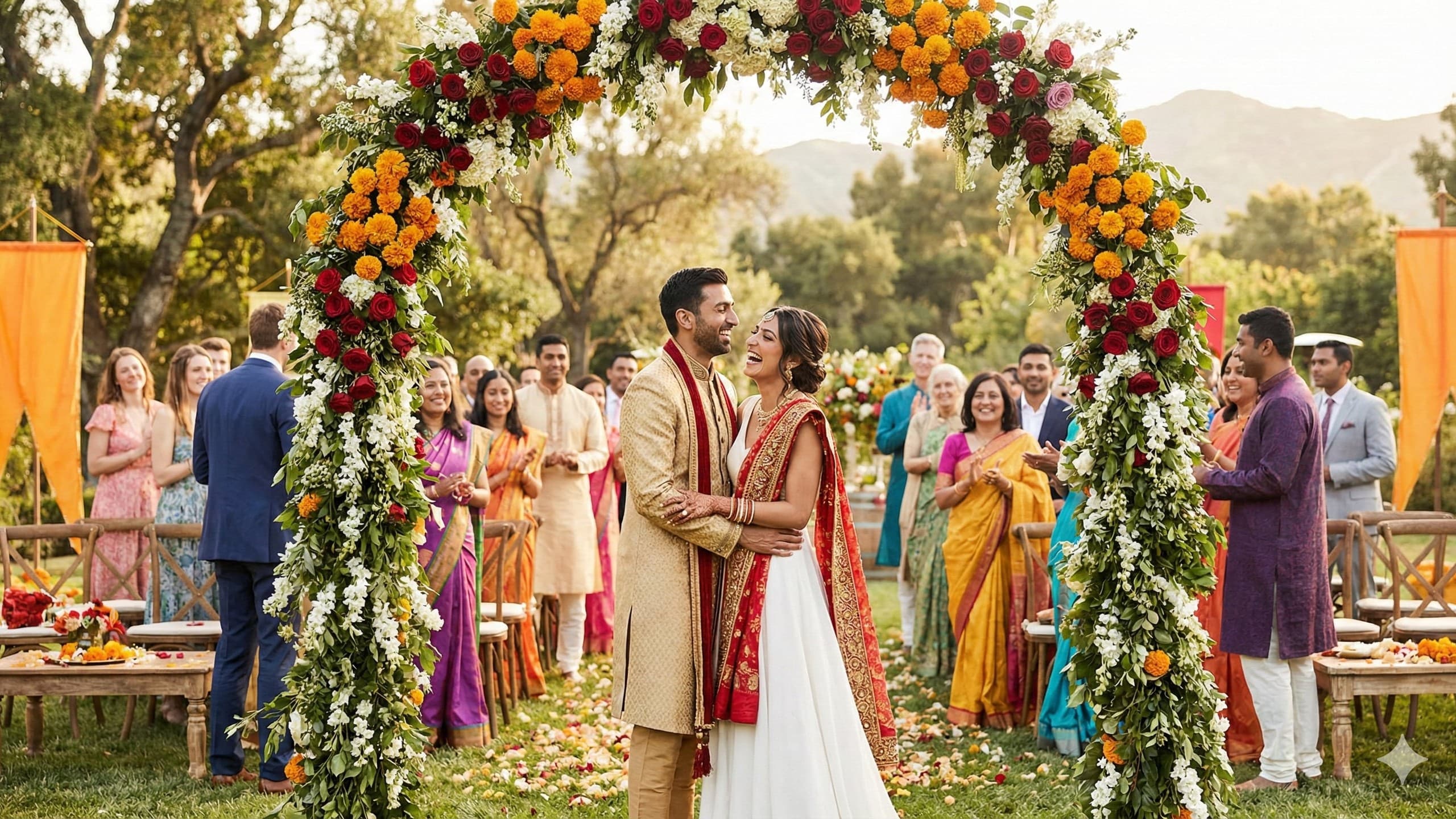
When Priya and Michael sat down to plan their wedding, they faced a beautiful challenge that no standard planning guide could solve. Her Hindu family expected a multi-day celebration with a mehndi ceremony, a sangeet, and a traditional puja. His Irish-Catholic family envisioned a church ceremony followed by a reception with live music and dancing until midnight. Both families were right. Both traditions mattered. And somehow, these two people who fell in love across cultural lines needed to weave it all into a celebration that honored everyone.
Their story is not unusual. It is increasingly the norm. According to the Pew Research Center, the percentage of newlyweds in interracial or interethnic marriages has risen steadily to approximately 19% of all new marriages in the United States. When you include interfaith marriages, the numbers are even higher — roughly 21% of marriages in 2023 were between people of different religious backgrounds, according to the Public Religion Research Institute.
These numbers represent real couples navigating real complexity. A multicultural wedding is not simply a wedding with "diverse" decor. It is an exercise in diplomacy, creativity, empathy, and logistics that can produce the most meaningful and memorable celebrations imaginable — when done thoughtfully.
Starting the Conversation: Before You Plan Anything
Before you look at a single venue or taste a single hors d'oeuvre, you and your partner need to have a deep, honest conversation. Not about logistics — about values.
QUESTIONS TO ASK EACH OTHER
• Which traditions from your culture or religion feel essential to you personally, not just expected by your family?
• Which traditions are you flexible on or willing to modify?
• Are there elements from your partner's culture you would love to incorporate?
• How do your families feel about blending traditions? Are there potential points of resistance?
• Is there anything from either tradition that would feel disrespectful to combine or modify?
These conversations can be emotionally complex, especially when one partner feels less connected to their cultural traditions than the other. The goal is not to keep score or ensure a 50/50 split. It is to understand what genuinely matters to each of you and build from there.
INVOLVING FAMILIES EARLY
One of the most common mistakes in multicultural wedding planning is surprising families with decisions that have already been made. If your Korean mother finds out at the rehearsal dinner that there will be no pyebaek ceremony, or your Jewish grandmother learns the day of that the ceremony will not include a chuppah, the hurt is real and avoidable.
Have family conversations early and frame them as invitations, not announcements. "We want to include elements that are meaningful to both families. What traditions matter most to you?" opens a dialogue. "We have decided to do a combined ceremony" closes it.
Be prepared for disappointment. Not every family member will be thrilled about every decision. Your job is not to make everyone perfectly happy — it is to make decisions rooted in respect and communicate them with warmth.
Ceremony Structures That Work
The ceremony is usually the most complex part of a multicultural wedding to plan. There are several structural approaches, and each has its strengths.
THE COMBINED CEREMONY
This is the most common approach: a single ceremony that weaves together elements from both traditions. A Jewish-Christian ceremony might be performed under a chuppah, include a reading from the New Testament, feature the exchange of rings, and end with the breaking of the glass. A Hindu-Western ceremony might begin with a traditional baraat procession, include Western vows, and conclude with the saptapadi (seven steps around the sacred fire).
Strengths: Symbolically powerful. Demonstrates unity. One event for guests to attend.
Challenges: Requires an officiant (or co-officiants) comfortable with both traditions. Some elements from different religions may feel theologically inconsistent when placed side by side. Length can become an issue — a full Catholic mass combined with a full Hindu ceremony could run over two hours.
Tips for success:
• Select the 2-3 most meaningful elements from each tradition rather than trying to include everything
• Work with your officiant(s) on transitions between cultural segments so the ceremony flows naturally
• Provide a printed or digital program explaining each ritual so guests from both backgrounds can follow along and understand the significance
SEQUENTIAL CEREMONIES
Two separate ceremonies, one from each tradition, held back-to-back or on different days. A Friday nikah (Islamic ceremony) followed by a Saturday Western ceremony, for example, or a morning civil ceremony followed by an afternoon traditional ceremony.
Strengths: Each tradition gets its full expression without compromise. Family members who feel strongly about the integrity of their tradition are satisfied. Guests experience both cultures fully.
Challenges: Higher cost (two ceremonies, potentially two venues, possibly two outfits). Extended timeline. Guest fatigue if both occur on the same day. Determining which ceremony is "first" can be politically sensitive.
Tips for success:
• If holding both on the same day, keep each ceremony concise (20-30 minutes each)
• Schedule a break between them so guests can stretch and the couple can change attire if desired
• Consider whether all guests are invited to both or whether some attend only one
THE CULTURAL RECEPTION
Some couples opt for a single, secular or minimally religious ceremony and then infuse their cultural traditions into the reception. This approach works well when the ceremony itself is less culturally significant to the couple than the celebratory elements — the music, food, dancing, and rituals.
A Chinese tea ceremony during the cocktail hour, a Greek money dance during the reception, a Mexican lasso ceremony integrated into the toasts — these moments of cultural expression can be woven into the reception naturally and joyfully.
Bilingual Invitations and Communication
When your guest list spans multiple languages, your invitations need to speak to everyone. Bilingual invitations are not just a logistical necessity — they are a statement that both cultures are valued equally in this celebration.
FORMATTING OPTIONS
Side-by-side layout: The invitation features both languages on the same page, with one on the left and one on the right. This works well for languages that share similar script lengths (English and Spanish, for example).
Front-and-back layout: One language on the front, one on the back. This is particularly effective for languages with different scripts (English and Arabic, English and Chinese) where a side-by-side layout might feel cramped.
Separate inserts: Each language gets its own card within the invitation suite. This allows full design flexibility for each language but increases printing costs and envelope size.
RIGHT-TO-LEFT LANGUAGE CONSIDERATIONS
If one of your languages reads right-to-left — Arabic, Hebrew, Urdu, Farsi — the design needs to accommodate this structurally, not just linguistically. Text alignment, layout direction, and even the visual hierarchy of the invitation change when an RTL language is involved.
This is one area where digital invitations offer a significant advantage over print. Platforms designed with RTL support handle the layout, alignment, and text rendering automatically. Eventifia supports nine languages including Arabic with full RTL rendering, which means your Arabic-speaking guests receive an invitation that reads naturally, not a mirror-image afterthought. This level of linguistic attention signals respect in a way your guests will notice.
WHAT TO INCLUDE IN BOTH LANGUAGES
At minimum, include in both languages:
• The couple's names
• The date, time, and location
• RSVP instructions
• Any special event details (dress code, multi-day schedule)
Decide whether formal ceremonial language (religious invocations, parental hosting lines) appears in both languages or only in the language where it is traditionally expressed. There is no wrong answer — it depends on your families' preferences.
Food: The Most Delicious Challenge
Food is deeply cultural, and your wedding menu is an opportunity to celebrate both backgrounds in a way that every guest can enjoy. It is also where dietary conflicts most commonly arise.
STRATEGIES FOR MULTICULTURAL MENUS
The blended menu: Each course draws from a different culture. A Middle Eastern meze starter, an Italian pasta course, an Indian curry main, and a French dessert. This approach celebrates culinary diversity but requires a chef skilled in multiple cuisines.
The station approach: Multiple food stations, each representing a different culture. A taco station and a sushi station. A dim sum cart and a charcuterie spread. Stations allow guests to explore both cultures at their own pace and choose what appeals to them.
The separate-but-equal approach: A full menu from one tradition with highlighted dishes from the other woven in. If the primary meal is a traditional Italian dinner, include a samosa appetizer and a gulab jamun dessert to honor an Indian background.
DIETARY CONSIDERATIONS ACROSS CULTURES
Religious and cultural dietary restrictions must be handled with care:
• Halal requirements: All meat must be halal-certified. Many Muslim guests will not eat from a kitchen where non-halal meat was also prepared.
• Kosher requirements: Depending on the level of observance, this may require separate preparation, separate dishes, or a fully kosher caterer. At minimum, avoid mixing meat and dairy in the same course.
• Hindu vegetarianism: Many Hindu guests are vegetarian. Ensure vegetarian options are substantive, not afterthought side dishes.
• Alcohol considerations: If one family's tradition discourages or prohibits alcohol, consider a dry ceremony with alcohol available only at the reception, or designated alcohol-free zones and mocktail options.
Work with your caterer well in advance to communicate these needs. A good caterer will not treat them as restrictions but as opportunities to create a more thoughtful menu.
Navigating Family Expectations
This is the part no one writes about in wedding magazines. The emotional labor of balancing two families' expectations — especially when those expectations are rooted in deeply held cultural or religious beliefs — is real and often exhausting.
COMMON POINTS OF TENSION
"That's not how we do weddings." When one family is unfamiliar with the other's traditions, the unknown can feel threatening. Address this by educating gently. A phone call from your partner to your parents explaining the significance of a particular ritual does more than a printed program ever will.
Parental hosting roles. In many cultures, parents of the bride host the wedding. In others, both families share hosting. In some, the couple hosts themselves. When traditions differ on who "controls" the wedding, clarify roles early.
Attire expectations. Will the bride wear white? A red lehenga? Both at different points? Will the groom wear a tuxedo, a sherwani, or a kilt? These decisions are visible and symbolic, so discuss them openly.
Guest list imbalances. One culture may traditionally invite extended family to the hundreds, while the other keeps celebrations intimate. A wedding with 200 guests from one side and 50 from the other can feel unbalanced. Address the disparity openly and without judgment.
STRATEGIES THAT HELP
• Appoint a cultural liaison from each family — someone who understands both the traditions and the diplomacy needed to bridge them
• Create a wedding website with a "Our Traditions" page that explains both cultural elements to all guests
• Host a welcome event where both families can mingle before the wedding, breaking the ice in a low-pressure setting
• Give each family a dedicated moment — a toast, a ceremony element, a dance — where their tradition is the spotlight
Music and Entertainment Across Cultures
Music is one of the most joyful ways to blend cultures at a wedding. A reception that moves from Bollywood hits to Irish folk music to American pop creates an energy that is uniquely your own.
Practical considerations:
• If hiring a band, look for groups that can perform across genres, or consider having two musical acts
• Build your DJ playlist collaboratively, ensuring both cultures are well-represented
• Schedule cultural dances at specific times (the hora, the garba, the dabke) and brief guests on how to participate
• Music during the ceremony should reflect the tone you want — if blending traditions, use instrumental versions that transcend specific cultural associations
Your Multicultural Wedding Planning Checklist
☐ Have a values conversation with your partner about what matters most
☐ Consult with both families about their expectations and must-haves
☐ Choose a ceremony structure (combined, sequential, or cultural reception)
☐ Find an officiant or co-officiants experienced in multicultural ceremonies
☐ Design bilingual invitations that respect both languages' formatting
☐ Plan a menu that honors both cultures' culinary traditions
☐ Address dietary restrictions across cultural and religious lines
☐ Create a program or guide explaining cultural elements to all guests
☐ Select music that represents both backgrounds
☐ Plan attire for each event that honors relevant traditions
☐ Brief your photographer on key cultural moments to capture
☐ Prepare your emcee or DJ to pronounce names correctly and explain rituals
Technology That Speaks Every Language
Managing a multicultural wedding's communication is a unique challenge. When half your guest list speaks English and the other half speaks Arabic, Urdu, Mandarin, or Spanish, your communication system needs to be multilingual by design, not by workaround.
Eventifia was built with multicultural events in mind. The platform supports nine languages — including Arabic with full right-to-left rendering — so you can send invitations, track RSVPs, and communicate with guests in their preferred language. Each guest receives information in the language that feels natural to them, which is a small technical feature that carries enormous emotional weight.
When your Chinese grandmother receives a beautifully formatted invitation in Mandarin and your American college roommate receives theirs in English — both generated from the same event dashboard — that is technology serving love in the most practical way possible.
Final Thoughts
A multicultural wedding is more work than a single-tradition celebration. There is no getting around that. More conversations, more logistics, more compromise, more emotional navigation. But it is also more meaningful. When you stand at your ceremony and look out at guests from different countries, different faiths, different languages — all there because they love you — you are witnessing something that matters beyond your own wedding. You are watching two worlds choose to come together.
That is worth every difficult conversation, every logistical challenge, and every moment of planning that got you there.
Ready to plan your multicultural celebration? Start with Eventifia and manage your bilingual invitations, multi-event RSVPs, and diverse guest list in one beautiful, multilingual platform.