How to Write Wedding Invitation Wording That Sets the Perfect Tone
Find the perfect wedding invitation wording for every style. Includes formal, modern, and bilingual examples plus RSVP, dress code, and digital tips.
February 24, 20269 min read
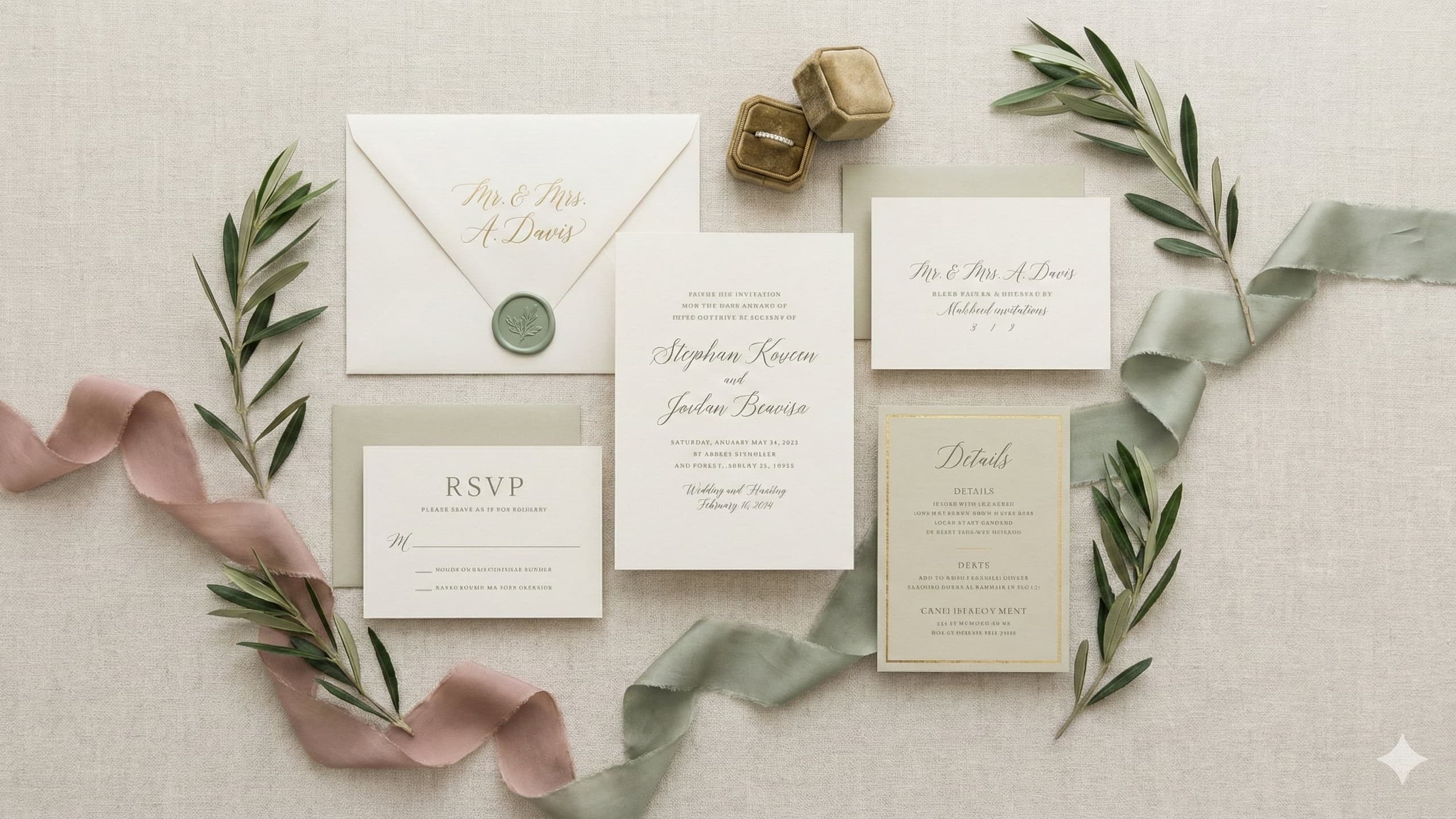
Introduction
Your wedding invitation is the first impression of your wedding. Before your guests see the venue, taste the food, or hear the music, they will read your invitation — and in those few carefully chosen sentences, they will understand exactly what kind of celebration to expect. A formal invitation with engraved script on heavyweight cotton paper tells one story. A playful digital invitation with a watercolor illustration and casual language tells another. Both are valid. The key is alignment between what your invitation promises and what your wedding delivers.
The good news: you do not need a degree in etiquette to get this right. What you need is clarity about your wedding's tone, an understanding of the basic structural elements every invitation requires, and enough examples to find the style that sounds like you. That is exactly what this guide provides.
The Anatomy of a Wedding Invitation
Regardless of style, every wedding invitation contains the same core elements, typically in this order:
1. The host line — who is inviting
2. The request line — the invitation itself
3. The couple's names — who is getting married
4. The date and time — when
5. The venue — where
6. Additional details — dress code, reception information, RSVP instructions, website URL
The tone of your wording transforms these elements from a formal announcement into a warm invitation. Let's look at how to handle each, with examples across the formality spectrum.
Who Is Hosting? The Host Line Explained
The host line traditionally indicates who is paying for the wedding. In 2026, this convention has loosened considerably, but it still matters to many families. Here are the common scenarios:
BRIDE'S PARENTS HOSTING (TRADITIONAL)
This is the most traditional format, historically indicating that the bride's parents are financing the wedding.
Mr. and Mrs. Robert Chen
request the honour of your presence
at the marriage of their daughter
Emily Grace
to
James William Patterson
BOTH SETS OF PARENTS HOSTING
When both families contribute, both are acknowledged.
Mr. and Mrs. Robert Chen
and
Mr. and Mrs. David Patterson
request the pleasure of your company
at the marriage of their children
Emily Grace Chen
and
James William Patterson
THE COUPLE HOSTING
Increasingly common in 2026, this format reflects couples funding their own celebration.
Together with their families,
Emily Chen and James Patterson
invite you to celebrate their marriage
Or, even more directly:
Emily Chen and James Patterson
request the pleasure of your company
at their wedding
DIVORCED PARENTS
When parents are divorced, list them on separate lines without "and" between them. Remarried parents include their current spouse.
Mrs. Linda Chen
and
Mr. Robert Chen
request the pleasure of your company
at the marriage of their daughter
Emily Grace
If a parent has remarried:
Mr. and Mrs. Thomas Walker
(mother and stepfather)
and
Mr. Robert Chen
(father)
request the pleasure of your company...
DECEASED PARENT
If a parent is deceased, they are not listed in the host line, but the invitation can be worded to honor them.
Emily Grace Chen,
daughter of the late Robert Chen and Mrs. Linda Chen,
and James William Patterson
invite you to share in the joy of their marriage
Formal, Semi-Formal, and Casual Wording Examples
ULTRA-FORMAL / BLACK-TIE
Ultra-formal invitations use "honour" (British spelling), full names with titles, written-out dates, and restrained language.
Mr. and Mrs. Robert Allen Chen
request the honour of your presence
at the marriage of their daughter
Emily Grace
to
Mr. James William Patterson
son of Mr. and Mrs. David Charles Patterson
on Saturday, the twentieth of September
two thousand and twenty-six
at half past four in the afternoon
Saint Michael's Cathedral
412 Cathedral Avenue
Boston, Massachusetts
Reception to follow
The Four Seasons Hotel
Style notes: Spell out everything — numbers, dates, times. Use "honour" rather than "honor" for very formal invitations (this signals a religious ceremony). Do not use abbreviations. The bride's last name is omitted if her parents are hosting (it is implied).
SEMI-FORMAL / CLASSIC
The most popular tone in 2026, semi-formal wording balances tradition with warmth.
Together with their families,
Emily Chen and James Patterson
invite you to celebrate their marriage
Saturday, September 20, 2026
4:30 in the afternoon
The Gardens at Elm Park
200 Elm Street, Boston, Massachusetts
Dinner and dancing to follow
Please RSVP by August 15
eventifia.com/emily-and-james
Style notes: Numerals are acceptable for dates. The tone is warm but still elegant. "Celebrate their marriage" is softer than "request the honour of your presence." Including the RSVP method directly on the invitation is increasingly standard.
MODERN / CASUAL
For laid-back celebrations — backyard weddings, brunch receptions, destination weddings with close friends.
We're getting married!
Emily Chen & James Patterson
Join us for dinner, drinks, and dancing
as we tie the knot
September 20, 2026 | 5:00 PM
Beachside at The Waverly
Montauk, New York
RSVP at eventifia.com/emily-and-james
Or:
After years of Netflix debates and stolen fries,
Emily and James are making it official.
Come celebrate with us!
September 20, 2026 at 5 PM
The Waverly, Montauk, NY
Casual dress | RSVP by August 15
Style notes: Casual does not mean careless. The invitation should still clearly communicate all essential information. Humor works when it is genuinely funny and reflective of the couple's personality — forced whimsy feels awkward.
Including Essential Details
RSVP INSTRUCTIONS
Modern invitations should make RSVPing as easy as possible. Include one of the following:
• A URL to your wedding website or RSVP platform
• A QR code (especially effective on printed invitations that link to a digital RSVP)
• A response card with a pre-stamped return envelope (formal/traditional)
• An email address (acceptable for casual weddings)
Be explicit about your deadline: "Kindly respond by August 15, 2026."
If you are using a platform like Eventifia for digital invitations and RSVP tracking, your guests can respond directly from the invitation. This eliminates the need for a separate response card and ensures every response is recorded accurately in your guest management system — no lost mail, no illegible handwriting, no manual data entry.
DRESS CODE
If your wedding has a specific dress code, include it on the invitation or detail card. Common phrasing:
• Black Tie: "Black Tie" (this is clear and self-explanatory)
• Formal: "Formal Attire Requested"
• Semi-Formal: "Cocktail Attire"
• Dressy Casual: "Garden Party Attire" or "Smart Casual"
• Casual: "Come as you are" or "Casual dress welcome"
For destination weddings: "Resort Elegant" or "Island Formal" gives guests permission to dress up without overdressing for the climate.
RECEPTION DETAILS
If the ceremony and reception are in different locations, or if the reception format is non-obvious, clarify:
• "Dinner and dancing to follow" (full reception)
• "Cocktail reception immediately following" (shorter, no sit-down dinner)
• "Luncheon reception to follow at [location]" (daytime)
• "Dessert and dancing to follow" (non-traditional)
WEDDING WEBSITE
Including your wedding website URL has become standard practice. Place it on the invitation itself, a detail card within the suite, or both. Your website typically hosts:
• Travel and accommodation information
• The full weekend schedule (if multiple events)
• Registry information (never on the invitation itself — always on the website)
• An RSVP portal
• Your love story and wedding party introductions
Bilingual Wedding Invitation Wording
For multicultural couples, bilingual invitations require more than translation — they require cultural adaptation. A phrase that sounds elegant in English may not carry the same tone in Spanish, Arabic, or Mandarin.
PRINCIPLES FOR BILINGUAL INVITATIONS
Translate meaning, not words. A literal translation of "request the honour of your presence" may sound stilted in another language. Work with a native speaker to find phrasing that carries the same level of formality and warmth in both languages.
Respect each language's conventions. Arabic wedding invitations traditionally open with "Bismillah ir-Rahman ir-Rahim" (In the name of God, the Most Gracious, the Most Merciful). Spanish invitations often include the full names of both sets of parents. Chinese invitations may include both the Western and lunar calendar dates. Honor these conventions rather than forcing both languages to follow identical structures.
Layout matters. For languages with different scripts, consider:
• Side-by-side layout for languages of similar length
• Front-and-back layout for languages with different reading directions
• Separate inserts for maximum design flexibility per language
An example of bilingual English/Spanish wording:
English side:
Together with their families,
Sofia Reyes and Michael O'Brien
invite you to celebrate their marriage
October 18, 2026 at 5:00 PM
Villa Rosa, San Miguel de Allende, Mexico
Spanish side:
Con la bendicion de Dios y sus familias,
Sofia Reyes y Michael O'Brien
tienen el honor de invitarle a su boda
18 de octubre de 2026 a las 17:00 horas
Villa Rosa, San Miguel de Allende, Mexico
Notice the Spanish version includes "Con la bendicion de Dios" (With God's blessing) — a culturally appropriate addition that would not typically appear in the English version. This is not inconsistency; it is cultural respect.
For couples working in languages that require right-to-left rendering — Arabic, Hebrew, Urdu, Farsi — digital invitations designed with proper RTL support are essential. Eventifia's platform handles RTL formatting natively across nine languages, ensuring your Arabic or Hebrew invitation reads correctly without manual layout adjustments. This is a technical detail that carries real emotional weight for guests reading in their native language.
Digital vs. Paper Invitations
The digital-versus-paper debate is increasingly settled in 2026: both are socially acceptable, and the choice depends on your wedding's formality, your values, and your budget.
WHEN TO CHOOSE PAPER
• Ultra-formal or black-tie weddings where the invitation is part of the aesthetic experience
• Cultural contexts where printed invitations carry significant respect or tradition
• When you want a tangible keepsake for guests (some people frame beautiful invitations)
WHEN TO CHOOSE DIGITAL
• Budget-conscious weddings (digital invitations cost a fraction of printed suites)
• Eco-conscious couples reducing paper waste
• Destination weddings where international mail is unreliable or slow
• Tech-comfortable guest lists
• When you want integrated RSVP tracking
THE HYBRID APPROACH
Send printed invitations with a QR code linking to your digital RSVP. You get the tactile elegance of paper with the logistical efficiency of digital tracking. Guests scan the code, respond online, and their information flows directly into your guest management system.
Common Wording Mistakes to Avoid
Including registry information on the invitation. Never. Registry details belong on your wedding website. Including them on the invitation implies that gifts are expected as the price of admission.
Misspelling guest names. Double-check every name before sending. Nothing signals carelessness like a misspelled name on a formal document.
Ambiguous plus-one language. If a guest has a plus-one, address the invitation to "[Name] and Guest." If they do not, address it only to their name. Do not rely on implied understanding.
Overloading the invitation with information. The invitation should contain the essential who, when, where, and how-to-RSVP. Everything else — hotel blocks, weekend schedule, parking instructions — belongs on detail cards or your wedding website.
Using inconsistent formality. If your invitation says "request the honour of your presence" but your RSVP instructions say "text us by August 15," the tonal whiplash is jarring. Keep the formality level consistent across all elements.
Your Invitation Wording Checklist
☐ Decide who is hosting and draft the host line accordingly
☐ Choose a formality level that matches your wedding's tone
☐ Include the couple's names in the style that reflects your relationship
☐ Spell out the date and time (formal) or use numerals (semi-formal and casual)
☐ Include the full venue name and address
☐ Add reception details if the location or format differs from the ceremony
☐ Include a clear RSVP method and deadline
☐ Add your wedding website URL
☐ Include dress code if applicable
☐ For bilingual invitations, have native speakers review both versions
☐ Proofread every name, date, time, and address
☐ Order or design 10-15% more invitations than your guest count (for errors and keepsakes)
Final Thoughts
Your invitation wording is a small detail that carries outsized significance. It is the first communication your guests receive about your wedding, and it sets the emotional tone for everything that follows. Spend time on it. Read it aloud to each other. Ask whether it sounds like you — not like a template, not like someone else's wedding, but like an authentic expression of who you are as a couple and what your guests can expect.
Get the tone right, and everything that follows feels cohesive. Get the logistics right, and your guests arrive informed and excited. Get both right, and your invitation has done its job beautifully.
Ready to design and send your wedding invitations? Explore Eventifia's digital invitation tools — with multilingual support, integrated RSVP tracking, and beautiful templates that set exactly the right tone for your celebration.