How to Plan a Diwali Celebration: Your Complete Guide to the Festival of Lights
Plan a beautiful Diwali celebration with our complete guide covering puja ceremonies, decorations, food, activities, and inclusive hosting tips.
February 24, 202611 min read
Introduction
Diwali — or Deepavali, meaning "row of lights" — is one of the most widely celebrated festivals in the world. Every autumn, over a billion people across multiple faiths and continents illuminate their homes with diyas (oil lamps) and candles, share sweets with loved ones, and celebrate the enduring triumph of light over darkness, knowledge over ignorance, and good over evil.
While Diwali is most commonly associated with Hinduism, it holds deep significance for Sikh, Jain, and some Buddhist communities as well, each observing the festival through the lens of their own traditions and sacred histories. Planning a Diwali celebration means honoring this richness — creating an event that is joyful, inclusive, and deeply rooted in meaning.
Whether you are hosting a traditional puja ceremony, an elaborate dinner party, a community gathering, or a fusion celebration that introduces the festival to friends of all backgrounds, this guide will help you plan every detail with care and authenticity.
The Significance of Diwali Across Traditions
Understanding the spiritual and cultural roots of Diwali will help you plan a celebration that is meaningful rather than merely decorative.
IN HINDU TRADITION
For many Hindus, Diwali celebrates the return of Lord Rama, his wife Sita, and brother Lakshmana to the kingdom of Ayodhya after 14 years of exile and the defeat of the demon king Ravana, as told in the epic Ramayana. The people of Ayodhya lit rows of oil lamps to guide them home, giving the festival its name. In other Hindu traditions, Diwali honors Goddess Lakshmi (the goddess of wealth and prosperity), Lord Ganesha (the remover of obstacles), or Lord Krishna's defeat of the demon Narakasura.
IN SIKH TRADITION
Sikhs celebrate Diwali (often called Bandi Chhor Divas) to commemorate the release of Guru Hargobind Ji, the sixth Sikh Guru, from imprisonment in the Gwalior Fort in 1619. The Golden Temple in Amritsar is illuminated spectacularly for the occasion.
IN JAIN TRADITION
For the Jain community, Diwali marks the anniversary of Lord Mahavira's attainment of Moksha (liberation) in 527 BCE. It is a day of deep spiritual significance, marking the ultimate triumph of the soul over worldly attachments.
A SHARED CELEBRATION
Despite these different narratives, common threads unite all Diwali observances: the victory of light over darkness, the importance of family and community, the practice of generosity, and the renewal of hope for the year ahead.
The Five Days of Diwali Explained
Diwali is not a single day but a five-day festival, each day carrying its own rituals and significance. Understanding this will help you plan a celebration — or series of celebrations — that captures the full spirit of the occasion.
DAY 1: DHANTERAS
The festival begins with Dhanteras, a day dedicated to wealth and well-being. Many families purchase gold, silver, or new utensils on this day as an auspicious beginning. Homes are cleaned and decorated, and small diyas are lit at the entrance.
DAY 2: NARAKA CHATURDASHI (CHOTI DIWALI)
The second day commemorates Lord Krishna's victory over the demon Narakasura. It is sometimes called "Little Diwali." Many people wake early for an oil bath and begin the day with rangoli designs at their doorsteps.
DAY 3: DIWALI (MAIN DAY)
The principal day of celebration. Families perform Lakshmi Puja in the evening, light diyas and candles throughout their homes, exchange gifts and sweets, and enjoy fireworks. This is the day most people refer to when they speak of "Diwali."
DAY 4: GOVARDHAN PUJA / PADWA
This day celebrates Lord Krishna's lifting of Govardhan Hill and also marks the beginning of a new year in some Hindu calendar traditions. It is a day to honor the bond between husband and wife in some communities.
DAY 5: BHAI DOOJ
The festival concludes with Bhai Dooj, a day celebrating the bond between brothers and sisters, similar in spirit to Raksha Bandhan. Sisters apply a tilak (vermillion mark) on their brothers' foreheads and pray for their well-being.
Planning your Diwali celebration with an awareness of all five days allows you to create a richer experience. Eventifia supports multi-day event creation, enabling you to link Dhanteras, Choti Diwali, the main Diwali celebration, Govardhan Puja, and Bhai Dooj as connected sub-events — with guests able to RSVP to each individually while seeing the full festival schedule.
Planning Your Diwali Celebration
CHOOSING YOUR CELEBRATION FORMAT
Diwali celebrations range from intimate family pujas to grand community festivals. Consider what feels right for your situation:
• Traditional Home Puja and Dinner: An intimate gathering centered around the Lakshmi-Ganesha puja, followed by a home-cooked meal and sweets exchange. Typically 10-30 guests.
• Diwali Dinner Party: A larger social gathering with traditional food, music, and festivities. Can accommodate 30-100+ guests.
• Community Diwali Festival: A large-scale event with performances (classical dance, music), food stalls, activities for children, and a communal diya-lighting ceremony. These can draw hundreds or even thousands.
• Workplace Diwali Celebration: A shorter event during office hours, featuring sweets, decorations, and a brief explanation of the festival's significance for colleagues of all backgrounds.
PLANNING TIMELINE
2-3 Months Before Diwali:
• Set your date(s) and format
• Book a venue if hosting outside your home
• Begin planning your guest list
• If organizing a community event, form your committee and begin recruiting volunteers
1 Month Before:
• Send invitations (include information about dress code, timing, and any puja schedule)
• Plan your menu and begin sourcing specialty ingredients
• Order or begin making decorations (rangoli stencils, diyas, lights)
• Arrange for any entertainment (DJ, classical musicians, dance performers)
2 Weeks Before:
• Confirm RSVPs and finalize catering or cooking plans
• Purchase puja supplies (idols or images of Lakshmi and Ganesha, incense, flowers, kumkum, turmeric)
• Begin making sweets and snacks that store well (barfi, ladoo, chakli)
1 Week Before:
• Deep clean your home (this is a Diwali tradition itself — cleaning to welcome Lakshmi)
• Set up lights and preliminary decorations
• Prepare any advance food items
Day of Diwali:
• Create fresh rangoli at your entrance
• Light diyas throughout the home as evening approaches
• Set up the puja area with the murti (idol or image), flowers, sweets, and offerings
• Welcome guests with warmth and joy
Decorations: Creating the Festival of Lights
Diwali decor is about warmth, color, and the glow of many lights. Here are the key elements.
DIYAS (OIL LAMPS)
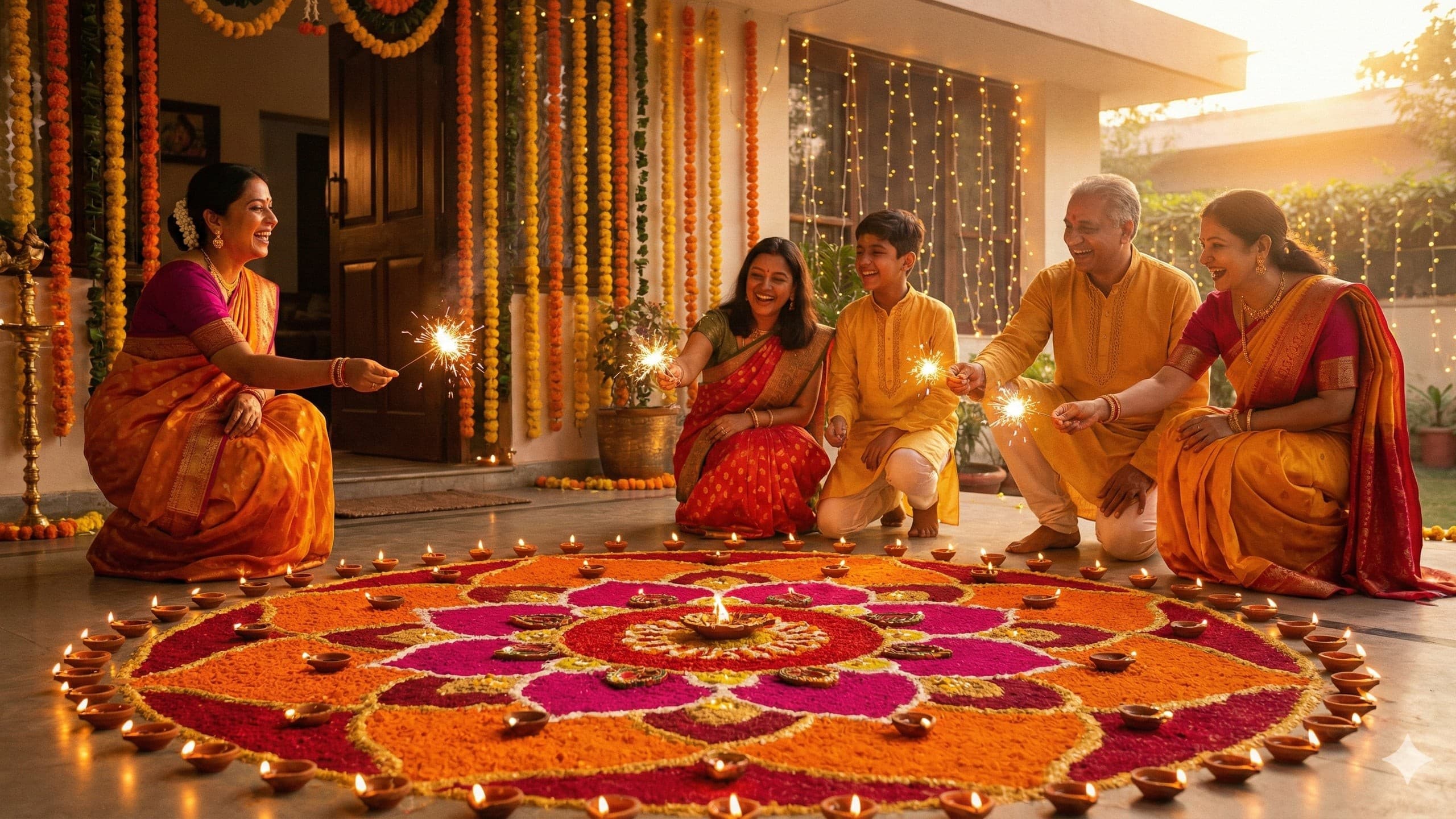
The heart of Diwali. Traditional clay diyas filled with mustard oil or ghee and a cotton wick are placed at entrances, windowsills, along pathways, and around the puja area. They symbolize the inner light that protects from spiritual darkness.
RANGOLI
Rangoli are intricate patterns created on the floor at the entrance of homes, typically made with colored powders, flower petals, rice, or sand. They welcome guests and are believed to bring good luck. Common motifs include lotus flowers, peacocks, diyas, and geometric patterns. If creating a rangoli feels daunting, stencils and sticker rangolis offer beautiful alternatives.
MARIGOLD GARLANDS (TORAN)
Strings of orange and yellow marigolds are draped across doorways and used as table centerpieces. Marigolds are considered auspicious in Hindu tradition and their warm color embodies the festival's spirit.
FAIRY LIGHTS AND CANDLES
Modern Diwali celebrations embrace electric lights alongside traditional diyas. Warm-toned fairy lights strung across rooms, balconies, and gardens create a magical atmosphere. Use them generously.
FRESH FLOWERS
Roses, jasmine, and marigolds are traditional. Arrange them in brass or copper vessels for an authentic touch.
TORANS AND WALL HANGINGS
Decorative door hangings (torans) made of mango leaves, marigolds, or beads are placed at the main entrance. Colorful wall hangings with mirror work or embroidery add festivity to interior spaces.
Food: A Feast for the Festival
Diwali food is rich, celebratory, and meant to be shared generously. The tradition of exchanging sweets (mithai) with neighbors, friends, and family is central to the festival.
TRADITIONAL SWEETS (MITHAI)
• Gulab Jamun: Deep-fried milk dumplings soaked in rose-scented sugar syrup
• Kaju Katli: Diamond-shaped cashew fudge, often presented in ornate boxes as gifts
• Barfi: A dense milk-based sweet available in many varieties (coconut, pistachio, almond)
• Ladoo: Round sweet balls made from gram flour (besan ladoo), semolina (rava ladoo), or coconut
• Rasgulla: Soft, spongy cottage cheese balls in sugar syrup (Bengali specialty)
• Jalebi: Deep-fried, pretzel-shaped sweets soaked in saffron-infused syrup
SAVORY SNACKS (NAMKEEN)
• Chakli/Murukku: Crunchy spiral-shaped snacks made from rice flour and spices
• Namak Pare: Crispy, diamond-shaped savory biscuits
• Mathri: Flaky, spiced crackers
• Mixture/Chivda: A crunchy snack mix of puffed rice, nuts, sev, and spices
• Samosas and Kachori: Stuffed savory pastries
MAIN MEAL IDEAS
For a Diwali dinner, consider a festive vegetarian spread (many families observe vegetarianism during Diwali):
• Paneer Tikka or Paneer Butter Masala
• Chole (Chickpea Curry) or Dal Makhani
• Aloo Gobi or Baingan Bharta
• Jeera Rice and Naan or Puri
• Raita and Pickles
Non-vegetarian options are also common depending on the family's tradition — biryani, butter chicken, or lamb curry are popular choices.
Activities and Entertainment
PUJA CEREMONY
If including a Lakshmi-Ganesha puja, prepare a dedicated space with:
• Idols or images of Goddess Lakshmi and Lord Ganesha
• Fresh flowers, especially marigolds and roses
• Incense (agarbatti) and camphor
• Fruits, sweets, and coconut as offerings
• Kumkum, turmeric, and rice
• A small bell and aarti lamp
The puja can be led by a family elder, a priest (pandit), or anyone knowledgeable in the rituals. For guests unfamiliar with puja, a brief, warm explanation before the ceremony helps everyone feel included.
CARD GAMES
Playing cards during Diwali is a popular tradition, believed to bring good fortune in the coming year. Friendly games of Teen Patti (Indian poker) or Rummy are common, often played for small stakes or simply for fun.
GIFT EXCHANGE
Diwali gifts typically include boxes of mithai, dry fruits, decorative items, clothing, or cash. Organizing a structured gift exchange — similar to a Secret Santa format — can be a fun addition for larger gatherings.
FIREWORKS AND ALTERNATIVES
Fireworks have been a traditional part of Diwali, but growing environmental and safety awareness has led many families to embrace alternatives:
• Sparklers (used with supervision for children)
• Sky lanterns (where legally permitted)
• Light-and-sound shows
• Communal laser light displays
• Extra diyas and candles for a stunning visual effect without noise or pollution
CHILDREN'S ACTIVITIES
• Rangoli-making stations with colored sand and stencils
• Diya-painting workshops
• Henna (mehndi) application
• Diwali-themed coloring and craft stations
• Storytelling sessions about the Ramayana or Diwali's significance
Dress Code and Attire
Diwali is an occasion to dress in your finest. Traditional Indian attire is common and welcomed:
• Women and girls: Sarees, salwar kameez, lehenga choli, or anarkali suits in rich colors — red, gold, pink, and jewel tones are popular
• Men and boys: Kurta pajama, sherwani, or nehru jacket
• For non-Indian guests: Any festive attire is wonderful. Wearing bright, warm colors shows appreciation for the celebration. If a guest wishes to wear Indian clothing, this is generally appreciated — choosing it respectfully and with genuine interest is the key.
Inviting Non-Hindu Friends: Inclusion and Education
Diwali is a celebration of universal values — the triumph of light, the importance of family, the spirit of generosity. Welcoming friends of other backgrounds enriches the celebration for everyone.
TIPS FOR INCLUSIVE HOSTING
• Include a brief explanation of Diwali in your invitation. A few sentences about the festival's meaning help guests feel oriented.
• Explain any customs they might observe, such as removing shoes at the entrance, the puja ceremony, and the significance of the food.
• Make participation comfortable. Guests do not need to be Hindu to enjoy rangoli-making, to light a diya, or to join in a card game. Frame activities as welcoming rather than obligatory.
• Be open to questions. Most guests ask because they are genuinely interested and want to be respectful.
• Label food clearly, noting any allergens and whether dishes are vegetarian or vegan.
Safety Considerations
Diwali involves many candles, diyas, and potentially fireworks. Safety should be a priority.
• Keep diyas and candles on stable, fireproof surfaces away from curtains and fabrics
• Supervise children around all open flames
• Have a fire extinguisher or bucket of water/sand accessible
• If using fireworks, follow all local laws and designate a safe area away from buildings and crowds
• Battery-operated LED diyas and candles offer a beautiful, safe alternative for homes with young children or pets
• Ensure clear pathways — diyas along walkways should be placed to the side, not where guests might trip
Bringing It All Together
A Diwali celebration, at its heart, is about gathering the people you love in a space filled with light, sharing food that has been prepared with care, and renewing your commitment to hope, goodness, and joy. Whether your celebration is a quiet puja with close family or a grand festival for your entire community, let authenticity and warmth guide your planning.
Every tradition, honored. Every guest, welcomed. Every light, a prayer for brighter days ahead.
Ready to plan a Diwali celebration that links all five days together seamlessly? Eventifia makes it easy to create multi-day events with linked sub-events, send bilingual invitations, manage RSVPs for large guest lists, and keep every detail organized. Whether you are planning an intimate family puja or a community festival, visit eventifia.com to start planning your Festival of Lights today.