How to Plan an Inclusive Multicultural Celebration That Honors Every Tradition
Plan inclusive multicultural celebrations with our guide to interfaith events, diverse workplace parties, and community gatherings that honor all traditions.
February 24, 202610 min read
Introduction
We live in a world of magnificent diversity. In many cities, a single apartment building may be home to families celebrating Diwali, Hanukkah, Christmas, Eid, Lunar New Year, and Kwanzaa — sometimes within the same month. Workplaces bring together colleagues whose personal calendars mark Passover and Easter, Navaratri and Thanksgiving, Vesak and Eid al-Adha. Interfaith families navigate the beautiful complexity of honoring both sets of traditions at every milestone.
In this landscape, the ability to plan celebrations that genuinely honor multiple traditions — without flattening them into a generic "holiday party" — is both a gift and a skill. Done well, multicultural celebrations become moments of connection, learning, and mutual respect. Done poorly, they risk superficiality, tokenism, or the unintentional exclusion of the very people they aim to include.
This guide provides a thoughtful, practical framework for planning inclusive multicultural celebrations across every setting — from interfaith family holidays to workplace gatherings, from school celebrations to community festivals.
Why Multicultural Celebrations Matter
Before diving into logistics, it is worth reflecting on why this effort matters.
BUILDING GENUINE UNDERSTANDING
When people share their traditions in a celebratory setting — explaining the significance of lighting the menorah, demonstrating how to make rangoli, or teaching a traditional song — something shifts. Abstract knowledge becomes lived experience. Differences become points of interest rather than distance. This kind of cultural exchange cannot be replicated by reading an article or watching a documentary; it requires the warmth of personal sharing.
COMBATING ISOLATION
For members of minority traditions in any given community, holiday seasons can be isolating. When the dominant culture's celebrations fill every public space, those who celebrate differently may feel invisible. A multicultural celebration says: "Your tradition matters here. You belong."
STRENGTHENING COMMUNITY
Communities that celebrate together develop deeper bonds. When a workplace celebrates Diwali alongside Christmas, or a neighborhood festival includes Eid alongside local harvest traditions, it signals that the community values all of its members — not just those who happen to belong to the majority.
ENRICHING EVERYONE'S EXPERIENCE
Multicultural celebrations are simply richer. More music, more food, more stories, more beauty. Exposure to diverse traditions expands everyone's world and often reveals surprising common ground between cultures.
The Planning Framework: Five Principles
Successful multicultural celebrations are built on five core principles.
1. RESEARCH BEFORE YOU PLAN
Never assume you know enough about any tradition to represent it accurately. Even well-intentioned efforts can go wrong without proper understanding.
Actions:
• Research the traditions you plan to include. Use authoritative sources — religious organizations, cultural institutions, and community leaders — rather than surface-level internet searches.
• Understand the significance of each tradition's symbols, foods, and practices. A diya is not just a pretty candle; a menorah is not just a candelabra; a Christmas wreath is not just a decoration. Each carries meaning.
• Be aware of what is sacred versus what is cultural. Some elements of traditions are deeply sacred and should not be treated as party decorations or entertainment.
2. CONSULT COMMUNITY MEMBERS
Research is necessary but not sufficient. The most important step is direct consultation with people who actually practice each tradition.
Actions:
• Identify representatives from each tradition in your community, workplace, or social circle.
• Ask them: "We want to include your tradition in our celebration. What would feel respectful and authentic to you? What should we avoid?"
• Invite them to be involved in the planning — not as token representatives, but as genuine collaborators.
• Listen to concerns without defensiveness. If someone tells you an idea is inappropriate, trust them.
3. FIND COMMON GROUND
Most traditions share certain universal values: gratitude, light in darkness, generosity, family, renewal, hope. Build your celebration around these shared themes rather than trying to merge distinct traditions into a single event.
Actions:
• Identify shared values across the traditions represented (e.g., "light" connects Diwali, Hanukkah, and Christmas; "gratitude" connects Thanksgiving, Eid, and harvest festivals).
• Use these shared values as your event's thematic foundation.
• Let each tradition express its unique version of these values rather than blending them together.
4. CREATE SPACE FOR INDIVIDUAL EXPRESSION
An inclusive celebration does not mean homogenizing every tradition into one generic event. It means creating a framework within which each tradition has its own distinct, honored space.
Actions:
• Rather than mixing all traditions together, consider creating distinct sections, stations, or moments for each.
• Allow community members to present their own traditions in their own way.
• Avoid the temptation to "explain" one tradition in terms of another ("Diwali is like the Hindu Christmas" — it is not, and the comparison diminishes both).
5. CELEBRATE, DO NOT APPROPRIATE
There is a meaningful difference between celebrating with a culture and appropriating from it. Celebration is participatory, respectful, and community-led. Appropriation takes elements out of context, often for aesthetic purposes, without understanding or permission.
Actions:
• Ensure that cultural elements are presented by or in consultation with members of that culture.
• Avoid using sacred symbols as mere decoration.
• When in doubt, ask: "Would a member of this community feel honored or uncomfortable seeing how we are presenting their tradition?"
Specific Scenarios and How to Navigate Them
INTERFAITH FAMILY HOLIDAYS
Interfaith families — where partners come from different religious or cultural backgrounds — face the beautiful challenge of honoring both traditions, especially during overlapping holiday seasons.
Planning approach:
• Both traditions deserve equal presence. If one partner is Jewish and the other is Christian, the December celebration should give equal weight to Hanukkah and Christmas — not present one as the "main" holiday with a nod to the other.
• Create combined rituals that honor both. Some families develop their own traditions that draw from both backgrounds — for example, lighting Hanukkah candles and then decorating the Christmas tree together.
• Educate children about both traditions fully. Help them understand the significance of each, so they grow up appreciating both heritages rather than seeing one as the default.
• Be prepared for extended family dynamics. Grandparents, aunts, and uncles may have strong feelings. Open, loving communication is key.
Practical tips:
• Allocate dedicated space for each tradition's symbols (a menorah and a Christmas tree, for instance, each displayed prominently)
• Prepare foods from both traditions
• If one tradition has a specific timing (e.g., Hanukkah candle lighting at sunset), honor that timing
• Invite extended family from both sides and help everyone feel included
WORKPLACE HOLIDAY PARTIES
The workplace holiday party is perhaps the most common — and most frequently mishandled — multicultural celebration scenario.
What to avoid:
• Calling it a "Christmas party" if your team includes people who do not celebrate Christmas
• The opposite extreme: stripping away all cultural specificity until the event has no identity at all (a generic "winter gathering" with no reference to any tradition can feel hollow)
• Assuming everyone celebrates something, or that everyone wants to celebrate at work
• Alcohol-centric events that exclude those who do not drink for religious, health, or personal reasons
What to do instead:
• Frame the event around gratitude and community — "a celebration of our team and the year we have shared"
• Invite employees to share their traditions. Set up a "traditions table" where people can bring a dish, a decoration, or a card explaining a holiday they celebrate. Make this voluntary, not mandatory.
• Include foods from multiple traditions on the menu (see the food section below)
• Acknowledge the season's diversity in your opening remarks: "This time of year, members of our team are celebrating Christmas, Hanukkah, Kwanzaa, the winter solstice, and more. Tonight, we celebrate all of you."
• Offer non-alcoholic options prominently — not hidden in a corner, but alongside other beverages with equal presentation
• Make attendance voluntary. Not everyone wants to celebrate at work, and that should be respected without consequence.
SCHOOL AND YOUTH CELEBRATIONS
Schools serve children from every background, and holiday celebrations must be handled with particular care.
Best practices:
• Focus on education alongside celebration — help children learn about multiple traditions through age-appropriate activities
• Invite parents from various backgrounds to share their family traditions (on a voluntary basis)
• Avoid singling out children as "representatives" of their culture — no child should be put on the spot to explain their family's religion
• Include activities that any child can participate in regardless of background: crafts, songs from multiple traditions, food tasting
• Communicate clearly with parents about what the celebration will include, and offer alternatives for families who do not wish their children to participate in certain activities
COMMUNITY FESTIVALS
Large community multicultural festivals bring together entire neighborhoods and can be transformative experiences.
Planning approach:
• Form a diverse organizing committee that includes representatives from the traditions and communities you aim to celebrate
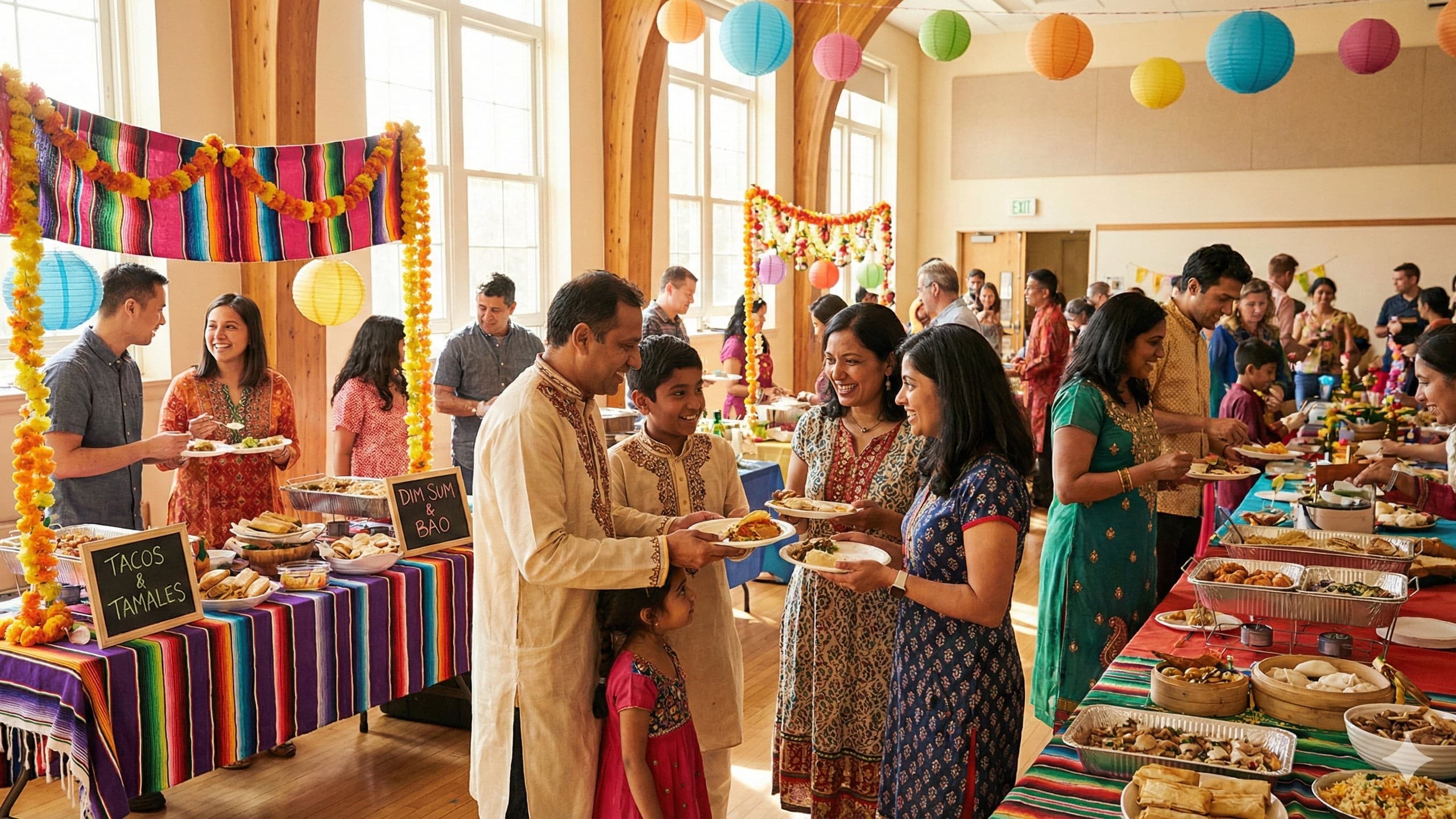
• Give each cultural group ownership over their section — rather than the committee designing an "Indian booth," invite members of the Indian community to create and run it themselves
• Include performances, food, art, and information from each represented culture
• Create programming that crosses cultural lines — a panel discussion on shared values, collaborative art projects, children's activities that draw from multiple traditions
• Be realistic about what you can do well. It is better to represent five traditions authentically than fifteen traditions superficially.
Food Considerations: Serving Everyone with Respect
Food is central to almost every celebration, and it is also where inclusion most directly meets practical logistics.
UNDERSTANDING MAJOR DIETARY TRADITIONS
• Halal (Islamic): No pork or pork derivatives, no alcohol in food or cooking, and meat must be slaughtered according to Islamic guidelines (zabiha). This is not simply a preference — it is a religious requirement.
• Kosher (Jewish): No pork or shellfish, no mixing of meat and dairy (in the same meal or with the same utensils), and meat must be slaughtered and prepared according to Jewish law. Kosher certification (hechsher) is required for strict observance.
• Hindu dietary practices: Many Hindus are vegetarian, and most avoid beef (the cow is considered sacred). Practices vary widely by region and family.
• Buddhist dietary practices: Many Buddhists practice vegetarianism, particularly on certain days. Practices vary by tradition.
• Jain dietary practices: Strict vegetarianism (no eggs), no root vegetables (as harvesting kills the plant), and many Jains avoid eating after sunset.
• Sikh dietary practices: Many Sikhs are vegetarian, and the langar (communal kitchen) in Gurdwaras serves vegetarian food to ensure inclusivity.
PRACTICAL CATERING STRATEGIES
• When in doubt, go vegetarian for shared dishes. A well-prepared vegetarian spread satisfies the widest range of dietary requirements (vegetarian is compatible with halal, kosher, Hindu, Buddhist, and most other dietary frameworks).
• If serving meat, ensure halal and kosher options are available — and clearly labeled. These should not be afterthought side dishes but full, satisfying meals.
• Prevent cross-contamination. Use separate serving utensils for dishes containing common allergens. If serving both meat and vegetarian options, keep them physically separated.
• Label everything clearly and accurately. Every dish should list its major ingredients and note common allergens (nuts, dairy, gluten, shellfish). Indicate whether each dish is vegetarian, vegan, halal, or kosher.
• Do not make assumptions about who eats what. Place labels on all dishes and let people choose for themselves.
• Ask about dietary needs in your RSVP. Capturing this information in advance allows you to plan accurately.
Eventifia captures dietary preferences and restrictions for every guest at the time of RSVP, giving you an exact count of how many halal, kosher, vegetarian, vegan, and allergen-free meals to prepare. This transforms what could be guesswork into precise planning.
Calendar Awareness: Navigating Overlapping Holidays
One of the unique challenges of multicultural planning is the overlay of multiple religious and cultural calendars.
KEY CONSIDERATIONS
• Many major holidays follow lunar or lunisolar calendars, meaning their Gregorian dates shift each year. Ramadan, Eid, Diwali, Lunar New Year, Hanukkah, and Easter all have variable dates.
• Be aware of fasting periods. Scheduling a food-centered event during Ramadan, Yom Kippur, Lent, or Navratri requires sensitivity. If fasting community members will attend, consider timing (after sunset during Ramadan, for instance) or offer the event outside fasting periods.
• Check for conflicts before setting your date. A quick review of major religious holidays for the year can prevent scheduling a company holiday party on the first night of Hanukkah or a community festival on Eid.
• When holidays overlap, acknowledge this as a gift, not a problem. Years when Hanukkah and Christmas overlap, or when Diwali falls near Halloween, present natural opportunities for cross-cultural celebration.
2026 HOLIDAY CALENDAR AWARENESS
A responsible multicultural event planner keeps a multi-tradition calendar accessible year-round. For 2026, notable dates include Ramadan (expected to begin in late February or early March), Easter (April 5 for Western churches, April 12 for most Eastern Orthodox churches), Eid al-Fitr (expected late March or early April), Diwali (expected in October), and Hanukkah (expected in December). Always verify exact dates as they approach, as many depend on astronomical observations.
Communication That Respects All Backgrounds
INVITATION LANGUAGE
• Use inclusive language: "You are warmly invited to our community celebration" rather than "Join us for our Christmas/Eid/Diwali party" — unless the event is specifically for one tradition.
• If the event does celebrate a specific tradition, name it with pride while making clear that guests of all backgrounds are welcome.
• For events that include multiple traditions, list them: "Join us for an evening celebrating Diwali, Thanksgiving, and the fall harvest."
• Provide key details in multiple languages if your community is multilingual.
DURING THE EVENT
• Welcome remarks should acknowledge the diversity in the room and express genuine gratitude for each tradition represented.
• Avoid ranking traditions or suggesting one is more important than another.
• When introducing cultural elements, let members of that culture speak for themselves rather than having an outsider explain their tradition.
• Use correct terminology. It is "Hanukkah" or "Chanukah," not "the Jewish Christmas." It is "Diwali," not "the Hindu version of Christmas." Each tradition stands on its own terms.
Eventifia supports invitations and communication in nine languages — English, Arabic, French, Turkish, Spanish, Portuguese, German, Italian, and Greek — with full RTL support for Arabic. This means your multicultural event can reach every community member in the language they are most comfortable with, ensuring that the inclusivity of your message is not limited by language barriers.
Decor That Celebrates Without Appropriating
GUIDELINES FOR RESPECTFUL DECORATION
• Use decorations associated with the celebration's theme (light, gratitude, harvest, community) rather than borrowing specific sacred symbols.
• If including tradition-specific decorations, involve community members in selecting and displaying them.
• Avoid mass-produced "ethnic" decorations that reduce complex traditions to stereotypical imagery.
• Natural elements work across cultures: candles and lights, flowers, greenery, and seasonal produce are universally appropriate.
• Create a global aesthetic — a warm, beautiful space that draws from many traditions without imitating any single one inappropriately.
IDEAS FOR MULTICULTURAL DECOR
• A "light" theme with candles, lanterns, string lights, and illuminated decorations — light is sacred across nearly every tradition
• Fresh flowers from different cultural contexts (marigolds, roses, lilies, chrysanthemums)
• A "world table" centerpiece featuring small artifacts or images contributed by community members
• A communal art installation where guests add their own element (a collaborative mural, a wish tree, a light wall)
Activity Planning That Educates and Includes
INTERACTIVE CULTURAL STATIONS
Set up stations around the room, each featuring a hands-on activity from a different tradition:
• Rangoli design (Diwali)
• Dreidel spinning and chocolate gelt (Hanukkah)
• Lantern making (Lunar New Year, Ramadan)
• Ornament decorating (Christmas)
• Mehndi/henna design (shared across South Asian and Middle Eastern cultures)
• Calligraphy (Arabic, Chinese, or Hebrew, depending on represented traditions)
STORYTELLING AND SHARING
Create a space in the program for voluntary storytelling — "In our family, we celebrate this season by..." This can be structured as a moderated panel, a casual fireside chat, or a series of short presentations. The key is that it is voluntary, not forced, and that every tradition gets equal attention and respect.
MUSIC AND PERFORMANCE
• Create a playlist that includes music from every represented tradition
• Invite performers from different cultural backgrounds
• Include communal singing where possible — many traditions have songs associated with their celebrations
• A "musical journey" format, where a host guides the audience through songs from different traditions with brief context, can be deeply engaging
COLLABORATIVE ACTIVITIES
Activities that bring people together across cultural lines:
• A communal cooking session where small groups each prepare a dish from a different tradition
• A "gratitude wall" where everyone writes what they are thankful for — a value shared across virtually every culture
• A collaborative art project that blends elements from multiple traditions
• A trivia game featuring questions about various traditions (educational and fun)
Common Mistakes to Avoid
• Tokenism: Including a single token element from a minority tradition while the celebration is overwhelmingly centered on the majority tradition.
• Exoticization: Treating minority traditions as "interesting" spectacles rather than living practices with deep personal meaning.
• Forced participation: Pressuring people to share about their tradition when they would rather simply attend and enjoy.
• Equivalence without equity: Giving all traditions equal time but not equal quality of representation (e.g., an elaborate Christmas section and a hastily assembled Hanukkah table).
• Ignoring feedback: If a community member tells you something feels wrong, take it seriously.
• Performative inclusion: Going through the motions of multicultural celebration without genuine understanding or care.
A Celebration of What Connects Us
The most powerful multicultural celebrations are those that leave guests feeling both proud of their own traditions and curious about others'. They do not erase differences — they honor them. They do not demand uniformity — they create space for both shared joy and individual expression.
When you plan a multicultural event with genuine respect, thorough research, and open collaboration with community members, you create something rare and precious: a gathering where every person feels that their heritage is valued, their presence matters, and their traditions are part of the tapestry, not an afterthought.
Plan your multicultural celebration with Eventifia — a platform built on the principle that every tradition deserves to be honored. With nine-language support (including full Arabic RTL), household grouping for family-centered cultures, timed communication that respects religious schedules, and community-focused design, Eventifia helps you create events where every guest truly belongs. Start planning at eventifia.com.