Lunar New Year Celebration Planning: Traditions Meet Modern Hosting
Plan a Lunar New Year celebration honoring Chinese, Korean, Vietnamese, and Tibetan traditions with our guide to food, decorations, and hosting.
February 24, 202610 min read
Introduction
When winter loosens its grip and the first signs of spring begin to stir, hundreds of millions of people across Asia and around the world prepare for one of humanity's oldest and most widely celebrated festivals: the Lunar New Year. It is a time of family reunion, ancestral remembrance, feasting, hope, and renewal — a moment to close the ledger on the old year and welcome the new with open hearts, clean homes, and red-adorned doorways.
The Lunar New Year is not a single monolithic celebration. It is a tapestry of traditions observed by Chinese, Korean, Vietnamese, Tibetan, Mongolian, and other Asian communities, each bringing their own customs, foods, and cultural meanings to the occasion. What unites them is the shared rhythm of the lunisolar calendar and the universal human desire to begin again — with gratitude for what has passed and optimism for what is to come.
Whether you are planning a family reunion dinner, a community festival, or a workplace celebration that introduces colleagues to Lunar New Year traditions, this guide will help you honor the occasion with authenticity, joy, and thoughtful hospitality.
The Lunar New Year Across Cultures
CHINESE NEW YEAR (CHUNJIE)
The most widely known observance, Chinese New Year is celebrated by Chinese communities worldwide and has significantly influenced Lunar New Year traditions in many other cultures. The festival marks the beginning of the new year on the traditional Chinese lunisolar calendar. It is the most important holiday in Chinese culture — a time when millions travel vast distances to reunite with family in what is often called the world's largest annual human migration (Chunyun).
KOREAN NEW YEAR (SEOLLAL)
Seollal is one of the two most important traditional Korean holidays (alongside Chuseok, the autumn harvest festival). Celebrated on the first day of the Korean lunisolar calendar, Seollal is centered on family rituals: the ancestral rite of Charye, where food offerings are made to ancestors; Sebae, where younger family members perform deep bows to their elders and receive blessings and money (sebaetdon); and the preparation and sharing of tteokguk (rice cake soup), which symbolizes gaining a year of age.
VIETNAMESE NEW YEAR (TET NGUYEN DAN)
Commonly known as Tet, the Vietnamese New Year is the most important celebration in Vietnamese culture. While sharing the same lunisolar calendar as Chinese New Year, Tet has its own distinct traditions: the Ong Tao ceremony (farewell to the Kitchen Gods), the flower markets (hoa mai in the south, hoa dao in the north), the preparation of banh chung or banh tet (sticky rice cakes), and the tradition of xong dat (the first visitor of the new year).
TIBETAN NEW YEAR (LOSAR)
Losar, meaning "new year" in Tibetan, is celebrated over fifteen days. Preparations begin in the twelfth month of the Tibetan calendar with special rituals, cleaning, and the making of ceremonial foods. The celebration incorporates Buddhist prayers, folk dances (Cham dance), burning of incense (sang), and the hanging of fresh prayer flags.
SHARED THEMES ACROSS CELEBRATIONS
Despite their differences, these celebrations share core themes:
• Family reunion as the central purpose
• Honoring ancestors through ritual and remembrance
• Thorough cleaning of the home (sweeping away bad fortune)
• Special foods prepared with symbolic meaning
• Red and gold decorations (particularly in Chinese and Vietnamese traditions)
• Gifts of money from elders to younger family members
• Hope for prosperity and good fortune in the year ahead
Key Traditions and Their Significance
CLEANING THE HOUSE
In the days before the new year, a thorough cleaning of the entire home is undertaken. This is not merely practical — it is deeply symbolic. Sweeping and cleaning represent the removal of bad luck, old grievances, and accumulated misfortune from the previous year, making space for fresh blessings. In Chinese tradition, cleaning should be completed before New Year's Eve, because sweeping on New Year's Day itself is believed to sweep away good fortune.
RED DECORATIONS
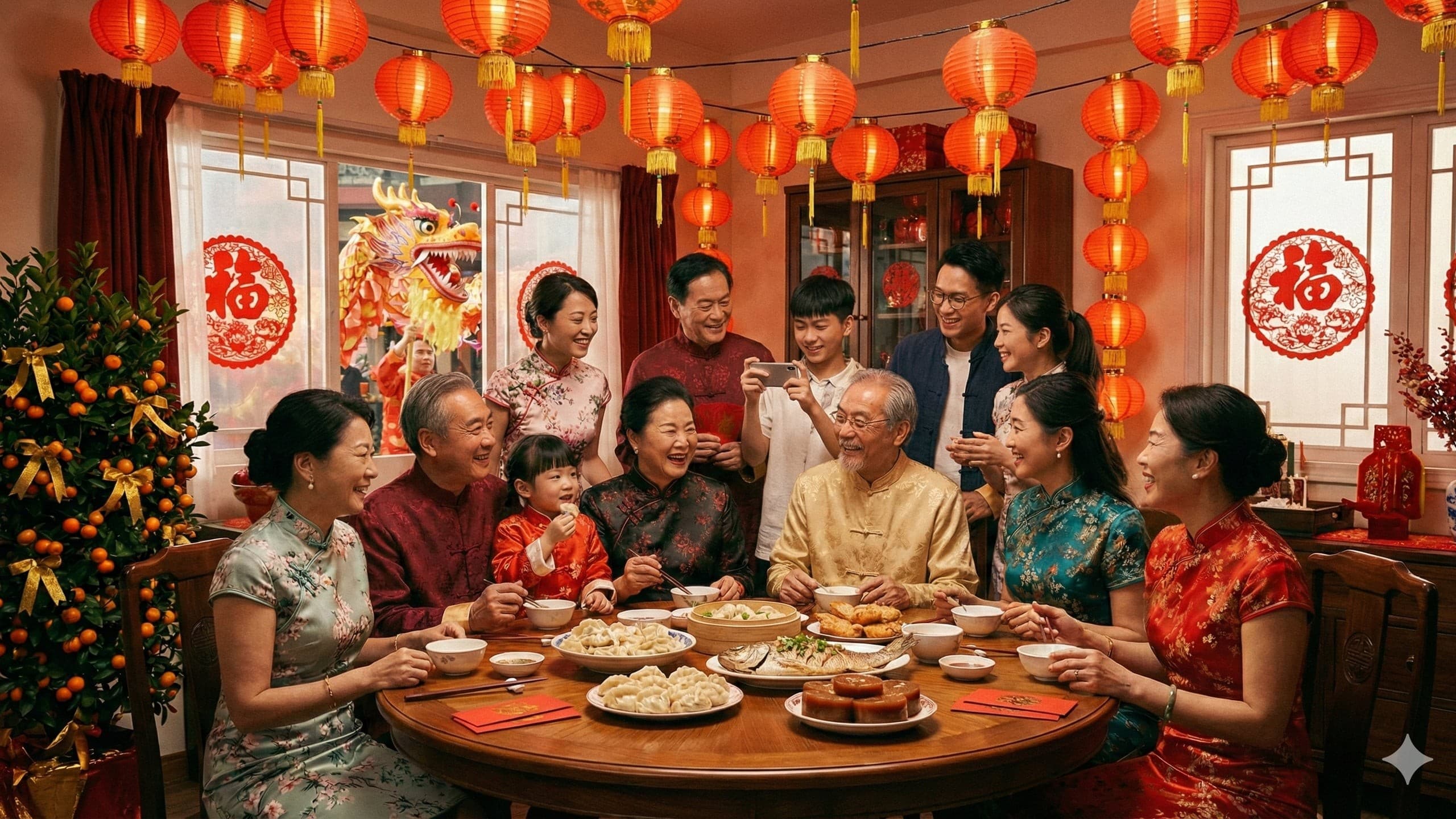
Red is the dominant color of Chinese and Vietnamese New Year celebrations, symbolizing luck, joy, and prosperity. In Chinese mythology, the color red is associated with the story of Nian, a fearsome beast that terrorized villages at the end of each year but was frightened away by the color red, loud noises, and fire. Red paper cuttings, red lanterns, red envelopes, and red couplets (duilian) hung on doorways all serve both decorative and symbolic purposes.
THE REUNION DINNER
The reunion dinner on New Year's Eve is the emotional heart of the celebration across all Lunar New Year traditions. Families gather — sometimes after traveling thousands of miles — to share a meal together. Every dish on the table carries symbolism: fish represents abundance (the Chinese word for fish, "yu," sounds like the word for surplus), dumplings resemble ancient Chinese gold ingots (symbolizing wealth), and noodles represent longevity.
RED ENVELOPES AND GIFT-GIVING
The tradition of red envelopes (hongbao in Chinese, li xi in Vietnamese, sebaetdon in Korean) is one of the most beloved aspects of the celebration. Elders give money enclosed in red envelopes to children and unmarried younger family members, symbolizing the transfer of blessings and good fortune. The amounts are often chosen for their symbolic significance — even numbers are preferred in Chinese tradition, and the number eight (which sounds like the word for prosperity) is especially auspicious.
LION AND DRAGON DANCES
Vibrant, rhythmic, and utterly captivating, lion and dragon dances are performed during the New Year period to bring good luck and drive away evil spirits. The lion dance is typically performed by two dancers — one operating the head and one the body — accompanied by drums, cymbals, and gongs. The dragon dance requires a team of dancers carrying a long, sinuous dragon on poles. Both are spectacular additions to community celebrations and festival programming.
FIRECRACKERS AND FIREWORKS
Firecrackers are believed to scare away evil spirits and welcome the new year with a bang — literally. The tradition is rooted in the same Nian legend as the color red. In many communities, firecrackers are set off at midnight on New Year's Eve and throughout the celebration period. Where firecrackers are restricted, recorded firecracker sounds or other noise-making alternatives are sometimes used.
The 15-Day Celebration Period
The Lunar New Year is not a single day — it is a festival that spans fifteen days, culminating in the Lantern Festival (Yuan Xiao Jie in Chinese tradition).
DAY 1-2: NEW YEAR'S DAY AND WELCOMING
• Wearing new clothes (often red or bright colors)
• Visiting family and elders
• Exchanging red envelopes
• Eating auspicious foods
• Avoiding sweeping, washing hair, or negative words (superstitions vary by family)
DAY 3-7: VISITING AND SOCIALIZING
• Extended family visits continue
• Friends and colleagues exchange greetings
• Temples are visited for prayers and blessings
• Markets and fairs operate with festive goods
DAY 8-14: COMMUNITY CELEBRATIONS
• Lion and dragon dances in Chinatowns and community centers
• Cultural performances and parades
• Temple fairs and food festivals
• Preparing for the Lantern Festival
DAY 15: THE LANTERN FESTIVAL (YUAN XIAO JIE)
The celebration concludes with the Lantern Festival, held on the night of the first full moon of the new year. Families light and display lanterns — from simple paper globes to elaborate sculptural works. Riddles are written on lanterns (caidengmi) for a communal guessing game. Traditional foods include tangyuan (sweet glutinous rice balls in soup), symbolizing family unity and completeness.
For hosts planning celebrations that span multiple days — a family reunion dinner on New Year's Eve, a community celebration on New Year's Day, and a Lantern Festival gathering two weeks later — Eventifia offers multi-day event support that links all celebrations together. Guests can see the entire schedule and RSVP to individual events, while you manage everything from a single dashboard.
Planning Your Gathering
FAMILY REUNION DINNER
The most intimate and important celebration. Whether you are hosting 8 or 80 family members:
Preparations:
• Clean the home thoroughly in the days before
• Decorate with red and gold: lanterns, paper cuttings, spring couplets at the doorway
• Plan a menu of symbolic dishes (see food section)
• Prepare red envelopes for younger family members
• Set up a small area for ancestral remembrance if your family observes this tradition
Evening flow:
• Family gathers in the late afternoon
• Ancestral offerings or prayers (if practiced)
• The reunion dinner — a long, leisurely, multi-course meal
• Red envelope distribution
• Card games and socializing (playing cards or mahjong is traditional in many families)
• Staying up until midnight to welcome the new year (Shou Sui)
• Firecrackers or noise at midnight
COMMUNITY CELEBRATION
A larger event for cultural organizations, community centers, or multicultural groups:
• Performances: Lion dance, dragon dance, traditional music, martial arts demonstrations
• Food stalls or a communal banquet featuring traditional dishes
• Craft activities: Paper cutting, lantern making, calligraphy
• Children's activities: Red envelope scavenger hunt, coloring stations, zodiac crafts
• Information displays about Lunar New Year traditions across cultures
• A zodiac year theme — decorate according to the year's animal
WORKPLACE CELEBRATION
A shorter event during office hours:
• Share traditional foods in a common area (dumplings, spring rolls, tangerines, nian gao)
• Display educational information about the Lunar New Year
• Invite employees who celebrate to share their family traditions (voluntarily)
• Decorate common areas with red lanterns and seasonal flowers
• Distribute tangerines (symbols of good fortune) or small red envelopes with chocolate coins
Traditional Foods and Their Symbolism
Food is never just food at the Lunar New Year — every dish is chosen for its symbolic meaning.
CHINESE NEW YEAR FOODS
Dish: Whole fish | Symbolism: Abundance and surplus (yu sounds like "surplus") — often served whole with head and tail
Dish: Dumplings (jiaozi) | Symbolism: Wealth (shaped like ancient gold ingots)
Dish: Spring rolls (chunjuan) | Symbolism: Wealth (golden color resembles gold bars)
Dish: Nian gao (sticky rice cake) | Symbolism: Growing prosperity year after year (nian gao sounds like "year higher")
Dish: Longevity noodles (changshou mian) | Symbolism: Long life — served uncut
Dish: Tangerines and oranges | Symbolism: Good luck and wealth (sounds like "gold" in several Chinese dialects)
Dish: Eight Treasure Rice (ba bao fan) | Symbolism: Sweetness and togetherness
Dish: Tang yuan (sweet rice balls) | Symbolism: Family unity and completeness (round shape)
KOREAN SEOLLAL FOODS
• Tteokguk (rice cake soup): Eating this symbolizes gaining a year of age and is essential for Seollal
• Japchae (stir-fried glass noodles): A celebratory dish for special occasions
• Jeon (savory pancakes): Various types (kimchijeon, hobakjeon) served as part of the ceremonial table
• Galbi (grilled short ribs) and Bulgogi: Festive meat dishes
VIETNAMESE TET FOODS
• Banh chung / Banh tet (sticky rice cakes): Square (northern) or cylindrical (southern) cakes filled with mung bean and pork, wrapped in banana leaves — the definitive Tet food
• Thit kho trung (braised pork and eggs): A southern Tet staple
• Gio lua (Vietnamese ham): Served as part of the Tet spread
• Mut (candied fruits and seeds): Served to guests with tea
• Xoi gac (red sticky rice): Bright red from gac fruit, auspicious in color
TIBETAN LOSAR FOODS
• Guthuk (special noodle soup): Served on New Year's Eve, with hidden objects in dumplings that playfully "predict" the finder's character
• Khapse (fried cookies): Ornamental fried dough in elaborate shapes
• Changkol (barley beer) and Butter tea (po cha)
• Dre-si (sweet saffron rice): Served on New Year's morning
Decorations
ESSENTIAL ELEMENTS
• Red lanterns: Hang them at entrances, along walkways, and as centerpieces
• Spring couplets (duilian or chunlian): Red banners with gold calligraphy hung on either side of the doorway, bearing auspicious wishes
• Paper cuttings (jianzhi): Intricate red paper art featuring the zodiac animal of the year, the character "fu" (fortune — often hung upside down, as the word for "upside down" sounds like "arrived," meaning "fortune has arrived"), and other auspicious symbols
• Kumquat or tangerine trees: Symbols of prosperity, these small citrus trees are traditional living decorations
• Fresh flowers: Plum blossoms, orchids, and chrysanthemums in Chinese tradition; hoa mai (yellow apricot) and hoa dao (peach blossoms) in Vietnamese tradition
• Gold and red color scheme throughout
ZODIAC YEAR THEMES
Each year is associated with one of twelve zodiac animals, and decorations can incorporate the year's animal:
• Rat, Ox, Tiger, Rabbit, Dragon, Snake, Horse, Goat/Sheep, Monkey, Rooster, Dog, Pig
Incorporating the year's zodiac animal into decorations, table settings, and activities (trivia about the zodiac animal, crafts for children) adds a playful and culturally authentic element.
Activities and Entertainment
LANTERN RIDDLES (CAIDENGMI)
Write riddles on paper and attach them to lanterns. Guests who solve the riddles win small prizes. This is a traditional Lantern Festival activity but works well throughout the celebration period.
TRADITIONAL GAMES
• Mahjong: A tile-based game deeply associated with Chinese New Year gatherings. For those unfamiliar, provide instructions or set up a learning table.
• Chinese chess (xiangqi): A strategic board game
• Yut Nori: A traditional Korean board game played during Seollal
• Card games: Various card games are played during New Year gatherings across Asian cultures
GIFT EXCHANGE
Organize a red envelope exchange where guests bring small gifts in red envelopes (not necessarily money — small treats, candies, or notes of good wishes work beautifully in social or workplace settings).
CULTURAL DEMONSTRATIONS
• Chinese calligraphy station where guests can have their names written in characters
• Paper-cutting workshop
• Dumpling-making station (interactive and delicious)
• Tea ceremony demonstration
Hosting Guests from Outside the Tradition
If your Lunar New Year celebration includes guests who are not familiar with the traditions, a few thoughtful touches help everyone feel welcome and engaged:
• Include a brief, warm explanation of the celebration's significance in your invitation
• Provide small printed guides at each table or station explaining the symbolism of foods and decorations
• Frame activities as invitations, not obligations — "Would you like to try making a dumpling?" rather than assuming comfort
• Welcome questions with genuine warmth
• Share the significance of the red envelope tradition if guests seem interested, but do not pressure anyone to give or receive
• Emphasize that the core values — family, gratitude, hope, generosity — are universal
Making Your Celebration Memorable
The most memorable Lunar New Year celebrations balance tradition with personal warmth. The food does not need to be restaurant-quality — a table of dumplings made together as a family carries more meaning than a catered banquet. The decorations do not need to be elaborate — a few red lanterns and a kumquat tree can transform a space. What matters most is the spirit of the gathering: the genuine joy of welcoming a new year surrounded by people you care about.
Plan your Lunar New Year celebrations with Eventifia. With multi-day event support for the entire 15-day festival period, multilingual invitations that reach every community member in their language, and guest management tools that handle everything from family reunion RSVPs to community festival registrations, Eventifia helps you honor tradition while embracing modern hosting. Start planning at eventifia.com.